Introduction
In most of the country, AC maintenance is a spring ritual. In Palm Beach County, it's a year-round obligation. West Palm Beach logs roughly 4,166 cooling degree days annually — more than three times the national average of 1,359 — which means your air conditioner almost never gets a break.
All those running hours add up. Without regular maintenance, AC systems gradually lose efficiency, energy bills climb, and components wear out ahead of schedule. What starts as a clogged filter or a slow drain line can escalate into a compressor failure or water damage — repairs that cost far more than any tune-up ever would.
This guide covers why maintenance matters financially and for your health, the four types of AC maintenance and when each applies, the warning signs that your system is struggling, and a practical maintenance schedule built for Florida's climate.
Key Takeaways
- Dirty or neglected ACs lose energy efficiency fast — and in Florida, that shows up directly on your FPL bill.
- AC maintenance breaks into four types: preventive, corrective, predictive, and major overhaul.
- Warning signs like weak airflow, strange noises, ice on the unit, or rising bills mean your system needs attention.
- Florida's year-round cooling demand means your AC needs maintenance more often than national guidelines suggest.
- At minimum: monthly filter checks, quarterly drain line inspections, and annual professional servicing.
Why AC Maintenance Matters
The Efficiency and Cost Case
A neglected AC doesn't just get dirtier — it gets less effective. Clogged filters force the system to work harder to move the same amount of air, dirty coils reduce heat transfer, and restricted airflow compounds both problems. The numbers back this up:
- Replacing a dirty, clogged filter can lower energy consumption by 5% to 15%, according to the U.S. Department of Energy.
- Airflow problems alone can reduce system efficiency by up to 15%, per ENERGY STAR.
- Dirty coils reduce cooling capacity, force longer run times, and accelerate equipment wear.
In Florida, this matters more than almost anywhere else. FPL reports that air conditioning can account for half or more of a home's electric bill — and up to 61% during peak cooling months. A 10–15% efficiency drop on a bill already dominated by cooling costs adds up quickly.
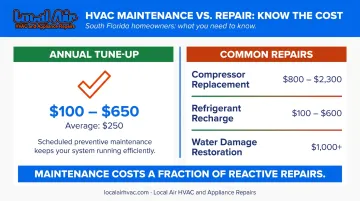
The repair math is even starker. A professional annual tune-up typically runs $100 to $650 nationally (averaging around $250, per Angi). Compare that to a compressor replacement at $800 to $2,300, a refrigerant recharge at $100 to $600, or water damage restoration from an overflowing condensate drain, which can run into the thousands.
Lifespan and Air Quality
A well-maintained central AC typically lasts 15 to 20 years, according to major manufacturers including Carrier, Lennox, and Trane. Neglected systems work harder, strain components faster, and fail sooner.
That same wear and deterioration creates a second problem: air quality. The EPA notes that mold in HVAC drip pans and drain lines can spread through the system if it isn't regularly cleaned.
The CDC links mold exposure to respiratory symptoms including coughing, wheezing, stuffy nose, and aggravated asthma. In South Florida's humid climate, biological buildup inside neglected systems accelerates — making this a more pressing concern here than in most of the country.
Types of AC Maintenance
Not all maintenance is the same. The right approach depends on your system's age, condition, and how hard it's been running.
Routine / Preventive Maintenance
This is the baseline — the regular upkeep that keeps a healthy system running well.
DIY tasks you can handle:
- Check and replace air filters monthly (ENERGY STAR recommends at least every 3 months; the DOE notes constant use, pets, or dusty conditions may require more frequent changes)
- Clear debris from around the outdoor condenser unit and maintain at least 2 feet of clearance
- Keep supply vents and return grilles unobstructed
- Inspect the condensate drain line quarterly and flush if needed
What a professional tune-up adds:
- Coil cleaning (indoor and outdoor)
- Refrigerant level check
- Electrical connection inspection
- Blower motor lubrication
- Full performance assessment
Preventive maintenance is sufficient for systems in good condition with no warning signs. For Palm Beach-area homeowners, annual professional servicing is the minimum — and a spring appointment before peak cooling season is ideal timing.
Corrective / Reactive Maintenance
This is the response to something that's already gone wrong: the unit stops cooling, freezes up, leaks water, or makes alarming noises.
Reactive maintenance is more expensive than planned maintenance. Emergency service calls carry premium pricing, and deferred problems tend to compound. A clogged condensate drain ignored long enough doesn't just reduce cooling — it can cause water damage to ceilings, walls, and flooring. That's not an HVAC bill anymore; it's a home repair bill.
Predictive / Condition-Based Maintenance
Rather than waiting for failure or sticking to a fixed schedule, predictive maintenance uses monitoring to catch problems early.
Easy ways to monitor performance:
- Track your energy bills month-over-month for unexplained spikes
- Note whether your AC is running longer cycles than usual to reach the set temperature
- Use a Google Nest thermostat — its System Health Monitor flags issues like "AC running longer than usual" or "AC not cooling" before they become full failures
- Ecobee and Honeywell thermostats offer similar filter reminders and performance alerts
Some HVAC companies now offer remote monitoring tools that can alert technicians to anomalies before a breakdown. Ask about this when scheduling a maintenance visit — it's a small step that can prevent a costly repair call.
Major / Overhaul Maintenance
When routine tune-ups aren't enough, a major overhaul provides a comprehensive reset. It covers:
- Full coil cleaning (interior and exterior)
- Refrigerant level check and recharge if needed (legally requires an EPA-certified technician)
- Blower motor inspection and lubrication
- Ductwork leak assessment
- Electrical component testing
When a major overhaul is warranted:
- Systems 5+ years old with no prior professional servicing
- Units showing persistent performance issues that tune-ups haven't resolved
- Pre-season deep service before Florida's most demanding cooling months
Local Air HVAC and Appliance Repairs is EPA Universal Certified, which means their technicians are qualified to handle refrigerant work as part of maintenance visits — an important credential given that federal law requires certification for refrigerant handling.
Warning Signs Your AC Needs Maintenance
Before a breakdown, most AC systems send signals. Catching them early keeps a minor fix from turning into a full system replacement.
Performance and Cooling Issues
- Longer run cycles — the system runs well past its usual cycle time without reaching the set temperature
- Uneven cooling — some rooms noticeably warmer than others
- Weak or warm airflow from vents — often caused by dirty coils, low refrigerant, or blocked airflow
- Ice on the evaporator coil or refrigerant lines — restricted airflow or refrigerant problems that require professional attention, not just a filter swap
Unusual Noises, Smells, or Behavior
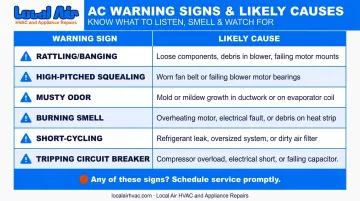
| Sign | Likely Cause |
|---|---|
| Rattling or banging | Loose components |
| High-pitched squealing | Motor or belt issue |
| Musty odor | Mold in drain pan or on coil |
| Burning smell | Electrical issue |
| Short-cycling (rapid on/off) | Refrigerant, electrical, or sizing issue |
| Tripping circuit breaker repeatedly | Electrical fault requiring immediate inspection |
Musty odors are especially common in South Florida homes. According to the CDC, mold exposure can trigger coughing, wheezing, and respiratory irritation — and Florida's humidity makes biological buildup on coils and in drain pans a persistent issue, not an occasional one.
Rising Energy Bills and Visible Wear
AC can account for more than half of an FPL bill in South Florida — so an unexplained spike in electricity costs, with no change in usage habits, is a direct signal the system is losing efficiency.
Visible warning signs to check:
- Water pooling around the indoor unit (clogged condensate drain)
- Rust or corrosion on the unit exterior
- Bent condenser fins
- A visibly dirty, gray air filter
In South Florida's heat and humidity, these issues compound fast — the longer they sit, the harder the system works.
AC Maintenance Schedule
South Florida's cooling demand is not average. With 4,166 annual cooling degree days in West Palm Beach — and nonzero cooling demand every month of the year, including January — national maintenance guidelines designed for seasonal climates simply don't apply here.
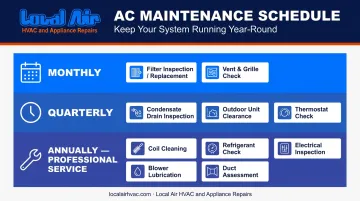
Monthly
- Inspect and replace air filters — every 1 to 3 months for most homes; monthly for homes with pets, allergies, or high dust levels
- Check that supply vents and return grilles are clear and unobstructed
Quarterly
- Inspect the condensate drain line for clogs; flush if needed
- Clear debris from the outdoor condenser unit; verify 2-foot clearance around the unit
- Confirm the thermostat is reading and responding accurately
Annually (Professional Service)
Schedule a comprehensive tune-up in spring, before peak cooling demand. A thorough professional visit should include:
- Indoor and outdoor coil cleaning
- Refrigerant level check
- Electrical connection inspection
- Blower motor lubrication
- Condensate drain flush
- Ductwork leak assessment
Local Air HVAC and Appliance Repairs has served Palm Beach and surrounding South Florida communities for over 20 years, performing full system inspections that cover every item on that list. Their EPA Universal Certified technicians can also handle refrigerant checks and recharges during the same visit.
Every 5–10 Years
Consider a full system evaluation if the unit is aging. ENERGY STAR recommends evaluating replacement for any AC more than 10 years old that requires frequent repairs or shows rising energy costs. A properly installed ENERGY STAR-certified replacement can reduce cooling costs by up to 20%.
A note on frequency: For older systems or homes where the AC runs continuously, bi-annual professional tune-ups are a smart move. Florida's year-round operation puts more hours on these systems in two years than some northern climates accumulate in five.
Conclusion
In South Florida, AC maintenance isn't a nice-to-have — a neglected system will cost far more in repairs and early replacement than routine upkeep ever will. Preventive maintenance runs a fraction of what reactive repairs do, and well-maintained units last years longer.
The plan doesn't need to be complicated. Monthly filter checks, quarterly drain line inspections, and an annual professional tune-up cover the vast majority of what keeps a system running efficiently. For older units or homes where the AC never really turns off, a second professional visit each year is worth scheduling.
If your system is due for service or you're unsure of its current condition, Local Air HVAC and Appliance Repairs can be reached at 561-331-7633 to schedule an inspection.
Frequently Asked Questions
What regular maintenance should be done on an air conditioner?
Replace air filters monthly, keep the outdoor condenser clear of debris, and inspect the condensate drain line quarterly. Schedule an annual professional tune-up covering coil cleaning, refrigerant checks, and electrical inspections. Older or heavily used systems may need that service twice a year.
Can AC cause sinus issues?
A poorly maintained AC can worsen sinus and respiratory symptoms. Dirty filters, mold in the drain pan, and excess humidity circulate allergens and irritants that the CDC links to coughing, wheezing, and nasal irritation. Regular filter replacement and coil cleaning significantly reduce this risk.
How often should I service my AC if I live in Florida?
At minimum, annual professional servicing with monthly filter checks and quarterly drain line inspections. For older systems or units running year-round, bi-annual tune-ups are worth scheduling. Florida's heat and humidity put significantly more hours on a system than most national guidelines are written for.
Can I do AC maintenance myself or do I need a professional?
Homeowners can handle filter replacements, debris clearing, and basic visual inspections. Refrigerant checks and recharges, electrical component work, coil deep-cleaning, and drain line flushing should be handled by a licensed, EPA-certified HVAC technician.
What happens if I skip AC maintenance?
Skipping maintenance leads to reduced efficiency, higher energy bills, and more frequent breakdowns. Clogged drain lines can cause water damage or mold growth. System lifespan also drops when components run harder than they're designed to.
How long does an air conditioner last with proper maintenance?
A well-maintained central AC typically lasts 15 to 20 years, according to manufacturers including Carrier, Lennox, and Trane. Systems that are neglected work harder, strain components faster, and tend to fail well before that threshold.