Skip service too long, and you're not just risking a breakdown. You're paying more every month in energy bills, shortening your system's lifespan, and setting yourself up for an expensive repair call in the middle of July. AC accounts for 27% of total energy consumed in Florida homes — more than four times the national average — which means an inefficient system hits your wallet fast.
This guide answers exactly how often you should service your AC in Broward County, what factors change that answer, and what signs mean you shouldn't wait for a scheduled visit.
Key Takeaways
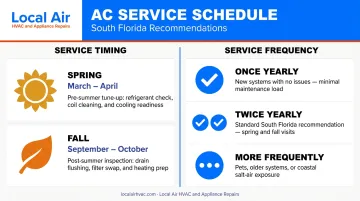
- Service your AC at least once per year — twice per year is the standard most HVAC professionals recommend for South Florida conditions
- Best windows: spring (March–April) before peak heat, fall (September–October) after heavy summer use
- Homes with pets, allergy sufferers, older systems, or coastal exposure need more frequent attention
- Skipping service raises energy bills and accelerates wear before a breakdown ever shows up
- Weak airflow, musty odors, or a sudden jump in electricity costs mean it's time to schedule a visit — don't wait
Why Broward County's Climate Demands More Frequent AC Servicing
Most U.S. homeowners run their AC four or five months a year. In Broward County, that number is closer to ten or eleven. FPL reports that South Florida central AC systems average approximately 2,800 annual cooling operating hours — a level of runtime that accelerates wear on every component in ways that national maintenance guidelines simply don't account for.
Humidity Attacks From the Inside
Broward's consistently high humidity creates problems that drier climates rarely face:
- Drain line clogs form faster when warm, moist air runs through the system constantly
- Coil moisture buildup promotes mold growth — UF/IFAS Extension notes most molds thrive above 60% relative humidity
- Mildew in the air handler develops during periods of reduced use
A Florida technician's maintenance checklist looks noticeably different from one used in Arizona or Colorado — and this is why.
Salt Air Corrodes What You Can't See
Coastal exposure adds another layer of wear that inland homeowners don't deal with. Carrier notes that salt water can be carried up to 2 miles inland, and corrosion severity depends on wind direction, humidity, and distance from the ocean — all factors Broward County communities contend with year-round.
Coils, electrical contacts, and refrigerant lines take the worst of it. By the time corrosion is visible on a unit, efficiency has already dropped and failure risk has climbed — which is exactly what routine inspections are designed to catch before it reaches that point.
No Off-Season to Reset
In northern climates, winter gives AC systems months of rest. Small developing issues stabilize, and technicians catch them at the next spring tune-up. Broward systems don't get that break.
The stakes are higher here: a minor drain blockage that might sit harmlessly for three months in Ohio can become a water damage situation within weeks in South Florida's heat and humidity.
How Often Should You Service Your AC in Broward County?
The minimum is once per year. The practical standard for South Florida is twice per year — and that recommendation comes from runtime data. A system logging 2,800 hours annually accumulates the same wear in one Florida year that a northern system might take two or three years to reach.
Based on System Usage and Household Conditions
Some homes put more stress on their systems than the runtime hours alone suggest:
- Pets: Hair and dander clog filters and coat coils faster, reducing airflow and forcing the system to work harder
- Allergy sufferers: Degraded filtration has real health consequences, not just efficiency ones
- Multiple occupants: Higher occupancy means more indoor air cycling and faster filter loading
- Rental or seasonal properties: Even low-use homes accumulate humidity-related issues; absentee owners are frequently surprised by drain backups or refrigerant problems that developed unnoticed
If any of these apply, twice-yearly service isn't optional — it's the baseline.
Based on System Age and History
System age changes the calculation significantly:
- Under 5 years old, no recurring issues: Once-yearly service may be sufficient
- Over 10 years old: Twice-yearly visits make sense — components like capacitors, contactors, and coils are more prone to failure at this stage, and longer inspection intervals mean less chance of catching problems before they escalate. Both FPL and ENERGY STAR identify 10 years as the threshold for evaluating system health and replacement planning.
- History of repeat issues: If your system has needed multiple drain cleanings, refrigerant top-offs, or electrical repairs, the root cause hasn't been resolved — and that calls for more frequent service, not less
Based on Seasonal Timing
Knowing how often to service your system is only half the equation. Timing those visits around Florida's climate cycle is what makes the difference:
- Spring (March–April): The primary service window. Catches wear from the prior year, prepares the system for peak summer demand, and lets technicians identify failing parts before summer schedules fill up
- Fall (September–October): After months of intense summer runtime, this visit checks coils, drain lines, electrical wear, and airflow before cooler months reduce demand
Signs Your AC Needs Servicing Sooner Than Planned
Routine maintenance keeps your system running on schedule — but some problems can't wait for the next planned visit. If you notice any of the following, your AC needs attention now:
- Weak or uneven cooling throughout the home
- System runs constantly without reaching the set temperature
- Unusual sounds — grinding, rattling, or squealing from the unit
- Musty or foul odors coming from vents
- Excess indoor humidity despite the AC running
A sudden unexplained spike in your electricity bill — without any change in usage habits — is one of the most reliable early warning signs. It typically means the system is working harder than it should due to a dirty coil, blocked drain, or refrigerant issue.
Don't wait until the next scheduled visit. In Broward County's heat, what starts as an efficiency problem can quickly become a costly repair. Dirty filters and coils can lead to premature compressor or fan failure. A compressor replacement in mid-July costs far more than a service call in April.
What Happens During a Professional AC Tune-Up?
A professional tune-up is a systematic inspection of every component that affects performance, safety, and efficiency — not just a filter swap.
What a Qualified Technician Should Cover
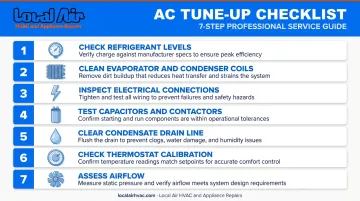
- Check refrigerant levels and pressures
- Clean evaporator and condenser coils
- Inspect and tighten electrical connections
- Test capacitors and contactors
- Clear and flush the condensate drain line
- Check thermostat calibration
- Assess airflow across the system
Of everything on that list, the condensate drain line deserves particular attention in South Florida. Blocked drains are among the most common causes of water damage and system shutdowns in the region — clogged channels prevent humidity reduction and can cause moisture damage to walls and ceilings.
What DIY Can't Replace
Changing your own filter matters. But professional service catches what homeowners can't:
- Refrigerant pressure readings require EPA certification and specialized gauges
- Electrical component testing identifies capacitors and contactors showing early failure before they stop working
- Coil condition assessment detects corrosion, fouling, and airflow restriction not visible from the outside
- Early mechanical wear detection catches issues that look and sound fine until they don't
Local Air HVAC and Appliance Repairs brings over 20 years of experience and EPA Universal Certification to every service call across the Palm Beach and surrounding South Florida area. Each maintenance visit covers the full checklist above — the components that take the most punishment in Florida's heat and humidity.
What Happens When AC Service Is Delayed or Skipped
Skipped maintenance rarely announces itself. The system keeps running — just less efficiently, and at greater cost each month.
Performance and Energy Costs
A Florida Solar Energy Center study monitoring 56 Florida homes found cooling performance degraded at a median rate of 5.2% annually. An ACEEE coil-fouling study found efficiency and capacity losses from fouling-related airflow reduction (buildup on coil surfaces) can reach 10–20% or more in marginal systems under extreme conditions.
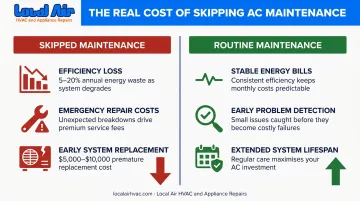
In practical terms: your system runs longer to deliver the same cooling, and you pay for every extra minute on your electric bill.
Repair Costs vs. Maintenance Costs
The financial math isn't complicated. A weakening capacitor caught during a scheduled tune-up costs a fraction of what it costs when it fails mid-summer and takes the compressor with it.
Emergency service demand peaks in July and August. At that point, parts lead times stretch and technician availability is tightest exactly when you need it most — a combination that turns a preventable repair into a multi-day ordeal.
Lifespan Impact
The FSEC study found median air-handler age at replacement was 13.5 years in Florida, with most replacements occurring between 14 and 18 years.
In Broward County's conditions — high humidity, year-round runtime — a neglected system typically reaches that replacement threshold years earlier than a maintained one. Replacing a system 4–5 years ahead of schedule can cost $5,000–$10,000 or more. That's the real cost of skipped service.
Frequently Asked Questions
Is AC servicing really necessary twice a year in Broward County?
For most homes, yes. Broward's near-year-round operation, persistent humidity, and coastal salt exposure create wear patterns that once-yearly service struggles to keep up with. Twice-yearly visits reflect the actual runtime and environmental stress these systems face — not an upsell.
What happens if I skip AC maintenance?
Drain lines clog, coils accumulate grime, and electrical components degrade without detection. The result is higher energy bills, weaker cooling performance, and a much higher chance of full system failure during peak summer — exactly when emergency service is hardest to book.
How long does a professional AC service appointment take?
Most comprehensive tune-ups take 60–90 minutes. Older systems or units with accumulated buildup may run longer depending on what the technician finds.
Should I schedule AC maintenance before hurricane season?
A spring service visit (March–April) is well-timed for this. It identifies drain, electrical, and reliability concerns before storms and peak heat place maximum demand on the system — and before HVAC schedules fill up completely.
Does AC maintenance affect indoor air quality and health?
Yes. A well-maintained system controls both temperature and humidity, which matters in South Florida's climate. A neglected unit with mold growth or degraded air quality can worsen the indoor environment — so the condition of the system is just as important as having one.
Can regular AC servicing prevent all breakdowns?
No — maintenance reduces breakdown risk significantly by catching problems early, but it can't guarantee zero failures. What it does is shift the odds heavily in your favor, and ensures that when issues do occur, they're more likely to be caught before they become emergencies.