Introduction
Your home's ductwork moves conditioned air to every room — but it also moves whatever accumulates inside it. Dust, pet dander, mold spores, and bacteria all hitch a ride through the same channels that are supposed to keep your family comfortable. For most homeowners, that system runs invisibly until something goes wrong.
In South Florida, the stakes are higher than in most places. Palm Beach County's year-round humidity creates conditions where mold and bacterial growth inside ductwork are genuinely common. When you factor in systems that run continuously rather than seasonally, contaminants build up faster and spread more consistently.
Knowing what to do about it starts with understanding what's actually happening inside those ducts. This guide covers the difference between cleaning, sanitizing, and disinfecting; the warning signs that service is overdue; who should prioritize sanitizing; and how to build a realistic maintenance schedule for a Florida climate.
Key Takeaways
- Cleaning removes physical debris; sanitizing reduces bacteria and mold — different tools, different purposes
- Florida's humidity makes biological growth in ductwork more likely than in drier climates
- Sanitizing isn't needed after every cleaning — it's most valuable after water damage, mold discovery, illness, or for allergy-prone households
- Most homes need professional cleaning every 3–5 years; sanitizing frequency depends on the specific triggers above
- EPA-registered products applied by certified technicians are the standard for safe, effective sanitizing
Why Air Duct Cleaning and Sanitizing Matter for Your Home's Health
Think of your ductwork as the respiratory system of your HVAC unit. Whatever collects inside those passages gets distributed to every room, every time the system runs. That includes the obvious stuff — dust, pet hair, construction debris — and the less visible: mold spores, bacteria, and allergens.
The Performance Problem
Debris buildup restricts airflow, which forces your system to run longer to reach thermostat setpoints. NADCA research indicates that contaminants throughout an HVAC system cause it to work harder and shorten its service life. HVAC equipment accounts for roughly 30% of energy use in an average home, making efficiency losses felt directly on monthly utility bills.
The EPA notes that cleaning dirty cooling coils, fans, and heat exchangers may improve system efficiency — though it also notes there's limited evidence that cleaning ducts alone drives meaningful energy savings. Duct cleaning is one piece of a broader HVAC maintenance strategy, not a standalone energy fix.
The Health Dimension
Circulating pollutants through dirty ductwork is a particular concern for:
- Children and elderly occupants
- Anyone with asthma or respiratory conditions
- Immunocompromised individuals
- Households with multiple pets
According to the CDC, people with asthma or mold allergies may experience severe reactions to mold exposure, and those with chronic lung disease or immune suppression face higher risk of fungal infections. In South Florida's year-round humidity, that risk is especially relevant — warm, moist air creates ideal conditions for mold growth inside ductwork.
The Cost Equation
Routine maintenance costs less than reactive remediation. Each of the following runs significantly more than a scheduled cleaning:
- Mold remediation inside ductwork
- Early HVAC replacement from accelerated component wear
- Repeated service calls for unexplained performance problems
Preventive service protects air quality and your budget at the same time.
Air Duct Cleaning vs. Sanitizing vs. Disinfecting: What's the Difference?
These three terms get used interchangeably, but they describe distinct services with different tools, purposes, and legal boundaries. Here's what each actually means.
Air Duct Cleaning
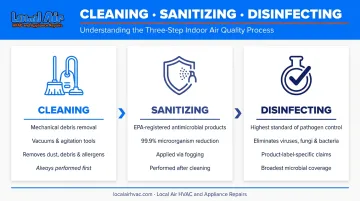
Cleaning is the mechanical removal of physical contaminants (dust, debris, pet hair, construction particles) using high-powered vacuums and agitation equipment under negative air pressure. NADCA's source-removal standard describes loosening contaminants from HVAC surfaces with agitation devices and extracting them with collection equipment.
Cleaning should always come first. The EPA and NADCA both treat source removal as the foundational service. Sanitizing applied over dirty ductwork is far less effective — you're treating surfaces that still have a physical layer of contaminants on them.
Air Duct Sanitizing
Sanitizing involves applying EPA-registered antimicrobial products (typically via fogging) to reduce bacteria, mold, and other microorganisms on duct surfaces after cleaning. Legally, a sanitizer must achieve 99.9% reduction of test microorganisms within five minutes under EPA OCSPP 810.2300 standards. It reduces biological contamination; it doesn't eliminate everything.
The fogging process aerosolizes the product under negative air pressure so it reaches interior duct surfaces.
How long protection lasts depends entirely on the specific product and its label conditions. One commonly cited EPA-registered product (SNiPER, EPA Reg. No. 71700-2) references a six-month interval for air ducts, but that applies to that product under those label conditions — not as a universal rule.
Air Duct Disinfecting
Disinfectants are held to a higher standard than sanitizers: they must eliminate specific viruses, fungi, and bacteria rather than just reduce them. Under FIFRA (the Federal Insecticide, Fungicide, and Rodenticide Act), antimicrobial products must be used strictly according to their EPA-registered label.
A technician cannot legally claim full duct disinfection unless the exact product label supports that claim for that surface, organism, and application method.
There's also a material constraint worth knowing: the EPA states that no chemical biocides are currently registered for use in internally insulated (fiberglass-lined) duct systems. Chemical treatment cannot be generalized across all duct types.
Who Actually Needs Sanitizing?
Sanitizing adds clear value in specific situations:
- Visible mold or persistent musty odors in ductwork
- Recent water damage or flooding near duct runs
- Occupants with allergies, asthma, or compromised immune systems
- Households with multiple pets
- Following illness in the home
- Post-renovation, where significant dust and debris have entered the system
It's not a routine add-on after every cleaning. A certified HVAC professional can assess whether your household conditions actually warrant it.
Warning Signs Your Air Ducts Need Cleaning or Sanitizing
Most homeowners don't think about their ductwork until something is obviously wrong. These are the indicators worth acting on — drawn directly from EPA guidance on when cleaning should be considered.
Visible Debris and Buildup
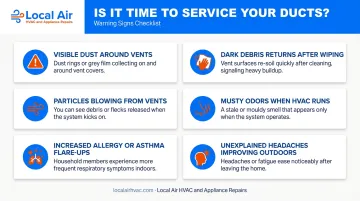
- Visible dust accumulation around vent registers
- Dark debris around vent covers that returns shortly after wiping
- Particles visibly blowing out of supply vents when the system starts
Pest activity is a more urgent signal than debris alone. Rodent droppings, insect debris, or nesting evidence near vents point to both cleaning and sanitizing. The EPA explicitly lists vermin infestation as a trigger condition for duct cleaning.
Air Quality and Odor Changes
Musty or stale odors when your HVAC runs are a direct indicator of mold or bacterial growth inside ductwork — especially common in Florida where humidity levels frequently challenge indoor air quality targets. The Florida Department of Health recommends keeping indoor humidity below 60%; the EPA recommends 30–50% for optimal indoor air quality control.
Watch for:
- Occupants experiencing increased allergy or asthma flare-ups
- Unexplained headaches or fatigue that improve when leaving the building
- Odors that intensify at system startup
HVAC Performance Issues
- Reduced airflow from supply vents despite normal system operation
- Rooms that are consistently harder to cool than others
- System running noticeably longer to reach thermostat setpoints
- Unexplained spikes in energy bills without a change in usage patterns
These symptoms often point to debris restriction inside the duct system. Because the same patterns can stem from other HVAC issues, a professional inspection is the best way to confirm the cause before scheduling service.
Life Events That Trigger Service
| Event | Recommended Action |
|---|---|
| Recent renovation or construction | Cleaning — drywall dust and debris enter duct systems easily |
| Moving into a previously owned home | Inspection + cleaning if history is unknown |
| Flooding or water intrusion near ducts | Cleaning + sanitizing |
| Several years since last professional service | Inspection to assess current condition |
Not sure which category applies to your home? Local Air HVAC's EPA Universal Certified technicians can assess your system and recommend whether cleaning alone or cleaning plus sanitizing makes sense for your situation.
Air Duct Cleaning and Sanitizing Schedule
There's no single schedule that fits every home. Frequency depends on household occupancy, pets, allergy sensitivities, and how hard your system works — factors that differ considerably between a year-round Palm Beach residence and a seasonal vacation property.
Maintenance Frequency Table
| Service | Typical Interval | Notes |
|---|---|---|
| Filter inspection/replacement | Every 1–3 months | More frequently with pets or high dust |
| Professional duct cleaning | Every 3–5 years (residential) | Every 2–3 years for pets, allergy households, or year-round Florida AC use |
| Air duct sanitizing | As needed | Every 1–2 years for at-risk households; after trigger events |
| Commercial properties | Annually or biannually | Higher occupancy and circulation demands |
| NADCA inspection standard | Annual (AHU); biennial (supply/return ducts) | Per ACR 2021 recommended inspection intervals |
Florida-Specific Considerations
Year-round AC use in South Florida means systems accumulate contaminants faster than seasonal ones. Continuous runtime shortens the effective interval between cleanings.
Moisture intrusion is the bigger risk. High ambient humidity means any water that enters ductwork — from a condensate leak, a flooding event, or persistently high indoor humidity — creates conditions for mold growth far more quickly than in drier climates.
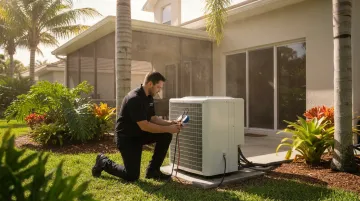
Vacation and seasonal properties present the opposite challenge: prolonged dormancy allows dust to settle throughout the system, and a property that's been closed for months may warrant an inspection before the system is put back into regular use.
The EPA's official position is that duct cleaning should be performed as needed rather than on a fixed routine — but "as needed" in Palm Beach County's climate means conditions that trigger service will arise more frequently than they would elsewhere.
Conclusion
Air duct cleaning and sanitizing work together, but they're not interchangeable. Cleaning removes the physical layer of dust, debris, and allergens. Sanitizing addresses the biological layer: bacteria, mold, and microorganisms that cleaning alone doesn't fully resolve. Sanitizing is only effective after thorough cleaning — skipping that step undermines the whole process.
For South Florida homeowners and businesses, year-round HVAC use combined with high humidity makes proactive duct maintenance more critical than in drier, more seasonal climates. The goal is practical: protecting occupant health, extending equipment life, and avoiding repair costs that grow the longer maintenance is deferred.
Local Air HVAC and Appliance Repairs has been serving South Palm Beach County and the surrounding area for over 20 years with EPA Universal Certified technicians. Contact them at 561-331-7633 to schedule a professional assessment and determine the right service approach for your home or business.
Frequently Asked Questions
What is the average cost to clean your air ducts?
Nationally, residential air duct cleaning averages around $389, with a typical range of $271–$509 according to HomeAdvisor 2025 data. Sanitizing is generally an add-on service quoted separately based on system size and conditions. Local Air serves Boca Raton, Delray Beach, Boynton Beach, and surrounding South Florida communities — call for an accurate local quote.
What is the difference between air duct cleaning and air duct sanitizing?
Cleaning mechanically removes dust, debris, and allergens using vacuums and agitation equipment. Sanitizing applies EPA-registered antimicrobial products to reduce bacteria and mold on duct surfaces after cleaning. Sanitizing works alongside cleaning as a follow-up treatment, not a substitute for it.
Is disinfecting air ducts worth it?
For homes with confirmed mold, recent water damage, immunocompromised occupants, or significant pet exposure, the value is clear. For a routine cleaning on an otherwise healthy system, it's generally not necessary.
How long does air duct sanitizing last?
Duration depends on the specific EPA-registered product used and its label conditions. Some products reference a six-month interval for air ducts; others vary. Normal air circulation gradually reintroduces biological matter over time, so periodic reapplication is expected.
How often should air ducts be cleaned?
Most residential homes benefit from professional cleaning every 3–5 years. Homes with pets, allergy sufferers, or year-round AC use in humid climates like Florida warrant more frequent service — closer to every 2–3 years.
Is air duct sanitizing safe for pets and children?
EPA-registered products used by certified professionals are formulated for low toxicity. Standard practice is to have pets and children vacate the area during application and for the re-entry period specified on the product label. Follow the technician's guidance on timing.