South Florida's climate makes this problem worse than most. With 4,174 annual cooling degree days at Palm Beach International Airport and positive cooling load every single month of the year, local HVAC systems run almost continuously. That means your ductwork accumulates dust, mold spores, and allergens at a faster rate than homes in drier or cooler parts of the country. Florida also has roughly 4 million allergy sufferers, and local plants don't follow the same predictable pollination patterns as the rest of the US.
This guide covers what a complete whole house air duct cleaning package actually includes, what it costs, how to spot a scam, and when cleaning genuinely makes sense — versus when it doesn't.
Key Takeaways
- A whole house package covers every supply vent, return duct, trunk line, and the air handler — not just the grilles you can see
- Expect to pay $300–$550 for most Palm Beach County homes based on national benchmarks; per-vent pricing of $25–$50 is the industry standard
- Florida's year-round AC use and high humidity justify cleaning every 2–3 years for most households — shorter than the national 3–5 year guideline
- Any "$99 whole-house" offer is bait-and-switch; a reputable job takes several hours and requires commercial-grade equipment
- Cleaning is clearly worth it when you see mold, pest activity, post-renovation debris, or have documented allergy or airflow problems
What Whole House Air Duct Cleaning Actually Covers
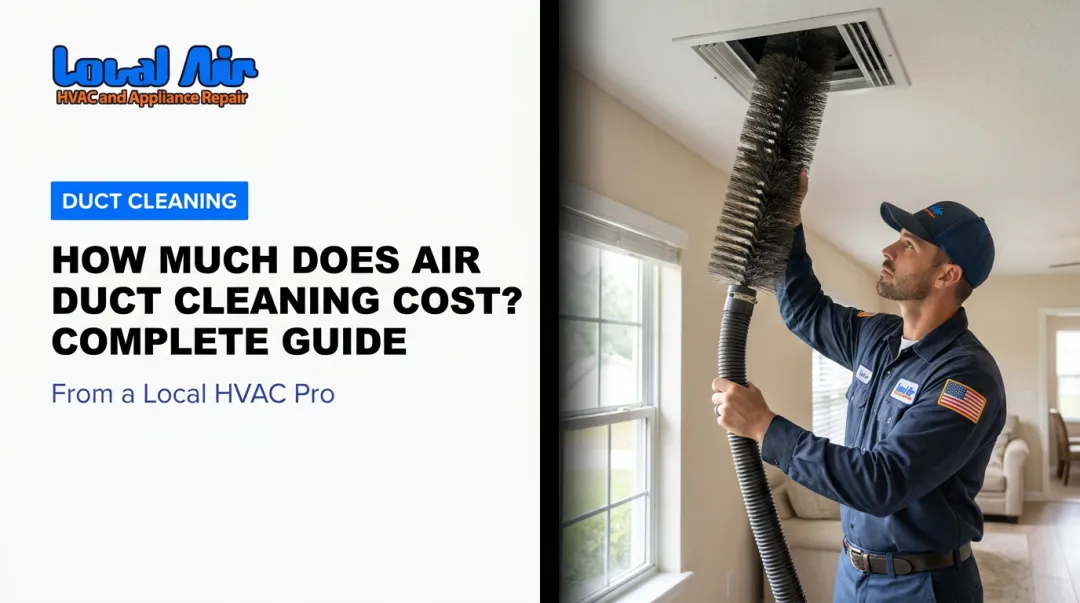
A whole house air duct cleaning is a professional service that removes accumulated dust, debris, allergens, and contaminants from your entire ductwork network. Technicians use commercial vacuum and agitation equipment to clean every section: supply ducts, return ducts, trunk lines, registers, and air handler components.
The "whole house" part matters. According to both the EPA and NADCA's ACR Standard, a complete cleaning covers:
- Supply and return ducts
- Registers, grilles, and diffusers
- Main trunk lines running from the air handler
- Fan motor and fan housing
- Air handler housing and coil compartments
- Condensate drain pans
A vent-only or basic cleaning covers only the accessible supply vents — the grilles a homeowner can reach. This misses the trunk lines, return ducts, and air handler, which are often the most contaminated sections.
Knowing what a full cleaning covers also clarifies what it isn't — and where HVAC maintenance fits in.
How It Differs from HVAC Maintenance
Duct cleaning and HVAC maintenance are related but separate. Maintenance focuses on mechanical performance — filters, refrigerant levels, electrical components, and coil condition. Duct cleaning targets the interior of the air distribution pathways where debris physically accumulates.
Some providers, including Local Air HVAC and Appliance Repairs (EPA Universal Certified, over 20 years serving Royal Palm Beach and South Palm Beach County), bundle both into a comprehensive indoor air quality service. If you're scheduling a cleaning, ask whether a system tune-up can be combined in the same visit.
Why Florida Homes Need This More Than Most
Palm Beach County's climate creates conditions that accelerate ductwork contamination in ways that don't apply to most of the country.
The key factors:
- Runs year-round: cooling degree days are recorded every month at KPBI, so your system never gets the rest period that slows debris buildup elsewhere
- Manages extreme moisture: NOAA reports a latent cooling load of 149,651 Btu/cfm for Palm Beach (a measure of the moisture your system must continuously remove)
- Creates mold-friendly conditions: the CDC notes that damp, humid environments can cause stuffy nose, wheezing, and eye irritation — with more severe reactions in people with asthma or mold allergies
- Delivers year-round allergens: Florida's non-standard pollination patterns mean pollen exposure doesn't stop in winter
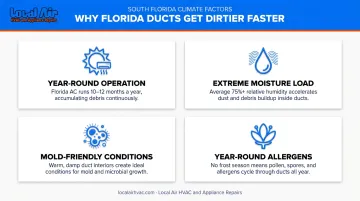
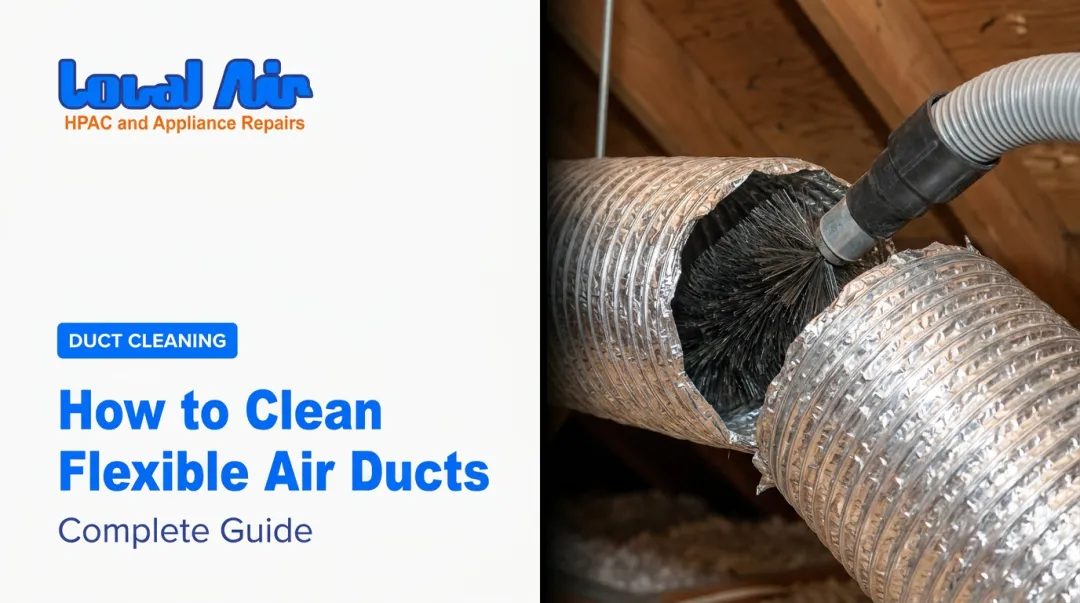
Flex duct systems — common in South Florida construction from the 1980s onward — are especially vulnerable. Their soft, insulated interiors have irregular surfaces where debris catches and clings far more readily than in smooth rigid metal ductwork.
The EPA notes that wet or moldy insulated ductwork cannot be effectively cleaned and must be replaced. Periodic inspection matters because catching contamination early avoids that outcome.
When ducts fill with debris, your HVAC system pushes harder to move conditioned air through restricted pathways. That strains the compressor, increases energy consumption, and shortens equipment lifespan — an expensive problem when your system runs 10–12 months a year.
What's Included in a Complete Package
Not all duct cleaning jobs are equal. A complete package covers the full system — a budget service usually doesn't.
Pre-Inspection and System Assessment
Before any cleaning begins, a thorough technician walks the home to:
- Count and inspect every supply and return vent
- Check the air handler for existing contamination or damage
- Identify sections with visible mold, pest activity, or physical deterioration
- Set accurate expectations about scope, time, and cost
Finding mold or pest evidence before work starts allows for proper remediation planning — not mid-job surprises.
Mechanical Agitation and Debris Extraction
This is the core of the service. Per NADCA's cleaning standards, the process involves:
- Negative pressure containment — the entire duct system is placed under continuous vacuum to prevent contaminants from escaping into the living space
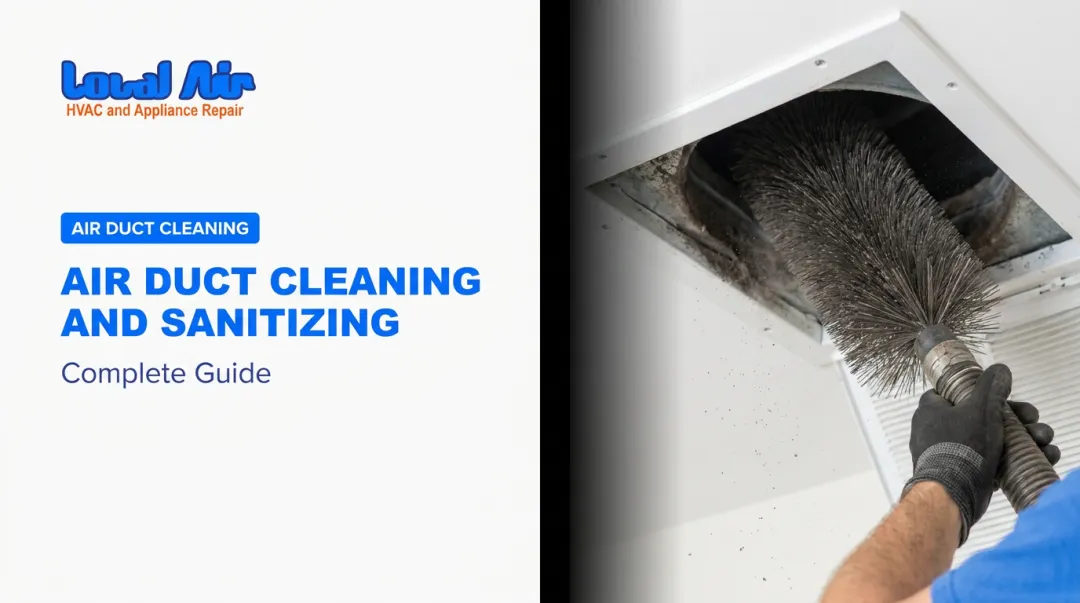
- Mechanical agitation — rotating brushes, air whips, or compressed-air tools physically dislodge caked-on debris from duct walls
- Collection — a high-powered vacuum (with HEPA filtration at 99.97% efficiency at 0.3 microns if exhausting indoors) pulls loosened debris out rather than recirculating it
- Trunk line cleaning — the main supply and return trunks running from the air handler are vacuumed, not just the branch runs to each room
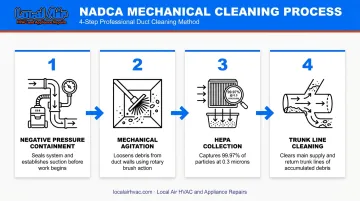
Trunk line cleaning is the clearest indicator of a complete job. If a technician doesn't mention it, ask directly.
Post-Cleaning and Optional Add-Ons
After cleaning, a reputable technician should:
- Walk through findings with the homeowner, including before-and-after documentation of duct interior condition
- Confirm restored airflow at key vents
- Apply EPA-registered antimicrobial treatment only where warranted (visible mold on non-porous surfaces, persistent odors) — not as an automatic upsell
Common add-on services and approximate ranges:
| Service | Approximate Range |
|---|---|
| Dryer vent cleaning | $185–$432 (national avg. ~$283) |
| AC coil cleaning | $75–$700 (national avg. ~$250) |
| UV light installation | Varies; contact provider for quote |
| Duct sealing | Varies by leakage extent |
Local Air offers dryer vent cleaning, UV light installation, and air conditioning maintenance as standalone or complementary services. UV lights installed at the coil and air handler are particularly useful in South Florida's humid climate, where biological buildup between cleanings is common.
What Affects the Cost
Whole house duct cleaning is most legitimately priced per vent ($25–$50 per vent) or per square foot ($0.15–$0.30/sq ft). A flat "whole-house" price with no vent count or size assessment is a red flag.
National benchmarks (use as reference for Palm Beach quotes):
- HomeAdvisor 2025 average: $389 (range $271–$508)
- Thumbtack 2025 average: $369 (range $241–$563)
No statewide Florida benchmark is published yet — get written quotes from local providers and compare scope, not just headline price.
What Drives the Final Number
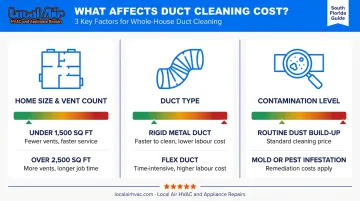
Home size and vent count:
- Under 1,500 sq ft / 8–12 vents → lower end of range
- Over 2,500 sq ft / 20+ vents or multiple zones → higher end
Duct type:
- Rigid metal ducts clean faster and at lower labor cost
- Flex duct (common throughout South Florida) requires more careful, time-intensive technique
Contamination level: Light routine dust falls under standard pricing. Mold, pest evidence, or years of neglect push costs much higher — and may require remediation beyond cleaning alone.
What's typically NOT included in a standard quote:
- Mold remediation (a separate scope entirely)
- Duct repair or replacement for damaged sections
- Asbestos testing (relevant for pre-1980 homes)
- Video inspection fees if not offered as part of a free estimate
Always ask for an itemized written scope before agreeing to any service. Once you know what's driving the price, it's easier to evaluate whether a quote reflects the actual work — or just a low number to get in the door.
Red Flags, Scams, and When Cleaning Isn't Necessary
The $99 Whole-House Scam
In 2020, the Washington State AG obtained a court ruling against air duct companies engaged in deceptive advertising and 13 million robocalls. Missouri's AG issued consumer warnings in 2023 about the same playbook: low-cost ads followed by high-pressure mold scare tactics once a technician is inside your home.
The setup is predictable — a technician arrives for a $99 job, claims to find severe mold or damage, and the price jumps to $1,000–$3,000. Equipment operation costs alone exceed $99 for a legitimate whole-home job, so the math never worked to begin with.
Before booking any provider:
- Ask for their Florida HVAC contractor license number and verify it at myfloridalicense.com
- Request an itemized written scope before work begins
- Be skeptical of mold claims without photographic documentation
When Cleaning Genuinely Isn't Necessary
The EPA does not recommend routine duct cleaning without a specific trigger. If indoor air quality is acceptable, filters are changed regularly, no mold or pest activity is present, and the home is relatively new, a full cleaning won't deliver measurable improvement.
That's not just a cost argument. A 2010 scientific review published in Indoor Air found that post-cleaning contaminant levels can actually be higher than pre-cleaning levels when the job is done poorly or performed without cause.
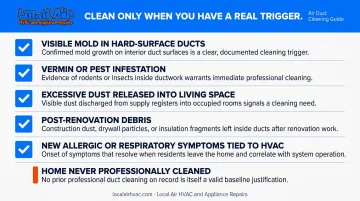
Clean only when you have a genuine trigger:
- Visible mold growth inside hard-surface ducts or on HVAC components
- Evidence of vermin or pest infestation in the ductwork
- Excessive dust or debris being released into the living space
- Post-renovation dust from remodeling work
- New allergic or respiratory symptoms that coincide with HVAC operation
- A home that has never been professionally cleaned
Frequently Asked Questions
How much should a whole house air duct cleaning package cost?
Expect $270–$510 for most homes based on national benchmarks, with per-vent pricing of $25–$50 being standard. A written quote should specify vent count and components covered. Any offer under $150 for a whole home should prompt questions about what's actually being cleaned.
Is a whole house air duct cleaning package worth it?
Yes — if you have a specific trigger. Visible mold, pest activity, post-renovation debris, documented allergy issues, or a home that's never been professionally cleaned all justify the investment. Without one of those conditions, routine cleaning may not deliver measurable improvement.
What is the 2-foot rule for air ducts?
There's no EPA-verified duct-specific "2-foot rule." The EPA's general mold guidance uses a 10-square-foot threshold (roughly 3×3 feet) for small-area cleanup. Visible mold inside ductwork — regardless of size — warrants professional assessment, not DIY treatment.
How long does a whole house air duct cleaning take?
Most single-system homes take 3–5 hours; larger homes with multiple systems can run longer. Duration depends on home size, contamination level, and crew size. Any company claiming to finish in under an hour is not doing a thorough job.
How often should air ducts be cleaned in Florida?
The EPA recommends cleaning based on need, not a fixed schedule. In South Florida, year-round AC use, high humidity, and persistent allergens change that calculus. Homes with pets, allergy sufferers, or any moisture history should target every 2–3 years — shorter than the national 3–5 year guideline.
What's the difference between a basic and a complete air duct cleaning package?
A basic service covers accessible supply vents only. A complete package includes return ducts, trunk lines, air handler inspection, and post-cleaning documentation. Always request a written scope of work before agreeing to any service.