Most business owners know maintenance matters. Fewer actually schedule it consistently. The default is reactive — wait until something breaks, then call for emergency service. That approach costs significantly more than the alternative, both in repair bills and in the operational disruption that follows.
This article covers the real, measurable benefits of regular commercial AC maintenance: lower energy costs, longer equipment life, better indoor air quality, and the financial case for treating service as a planned operating expense rather than a crisis response.
Key Takeaways
- Regular maintenance restores system efficiency, directly cutting monthly utility costs
- Preventive service extends equipment lifespan and reduces the need for emergency repairs
- Maintained systems manage humidity and filtration, which matter year-round in South Florida's climate
- Skipping maintenance shifts spending from planned, affordable service to expensive emergency repairs
- Florida's climate calls for at least twice-yearly service — high-demand buildings typically need quarterly visits
What Is Commercial AC Maintenance?
Commercial AC maintenance is a scheduled professional service program that inspects, cleans, calibrates, and addresses component wear before failure — not after. A technician visits on a defined schedule, performs a set checklist of tasks, and documents the system's condition along with any corrective actions taken.
This is different from residential service in ways that matter. Commercial systems are larger, serve multiple occupants simultaneously, and often run under high load for 10 to 12 months a year in Florida's climate.
When a residential unit fails, one household is uncomfortable. When a commercial system fails, the consequences compound quickly:
- Employees can't work, reducing productivity and morale
- Customers leave — and may not return
- In some lease arrangements, operational disruption creates legal exposure
Maintenance converts an unpredictable cost center into a managed, budgetable line item. A planned service visit costs a fraction of an emergency repair — and far less than premature equipment replacement.
Key Benefits of Commercial AC Maintenance
Each benefit below connects directly to outcomes that facility managers and business owners actually track: utility spend, repair costs, equipment ROI, occupant satisfaction, and operational continuity.
Benefit 1: Lower Energy Costs Through Improved Efficiency
HVAC represents a substantial share of commercial building energy use. According to EIA's 2018 Commercial Buildings Energy Consumption Survey, space cooling, heating, and ventilation together account for over half of major fuel consumption in U.S. commercial buildings.
ENERGY STAR has noted that 30% of the energy consumed in commercial buildings is wasted on average — much of it due to poorly maintained or inefficiently operated systems.
The mechanism is straightforward. When components degrade, the system works harder to deliver the same output:
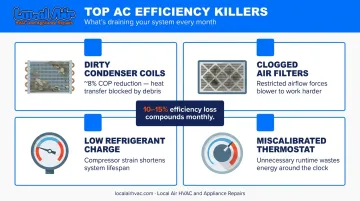
- Dirty condenser coils force the compressor to run longer cycles to reject heat
- Clogged air filters restrict airflow, reducing cooling capacity and increasing fan energy
- Low refrigerant charge reduces heat transfer efficiency and strains the compressor
- Miscalibrated thermostats cause the system to run when it shouldn't, or not run when it should
A Purdue University study on packaged AC units found that a 25% loss of evaporator airflow from fouling reduced both cooling capacity and efficiency (COP) by approximately 12%. Condenser coil blockage of 25% produced an additional 8% COP reduction. One year of normal dust loading reduced energy efficiency ratios by 1% to 10% across tested units.
In Palm Beach County, where cooling runs essentially year-round, even a modest efficiency loss compounds fast. A 10–15% efficiency penalty on a mid-size commercial system doesn't surface as a single large bill — it shows up as a persistent monthly overage that compounds for months before the source gets identified.
KPIs this affects: monthly utility spend, energy use per square foot, HVAC runtime hours, cost per ton of cooling
Benefit 2: Extended Equipment Lifespan and Fewer Emergency Repairs
Commercial HVAC equipment is a major capital asset. Replacing it ahead of schedule — because deferred maintenance accelerated wear — is one of the most avoidable costs in facilities management.
Regular maintenance prevents the chain-reaction failures that cause total system breakdowns. During each visit, a technician should:
- Inspect and lubricate bearings and moving parts
- Check and tighten electrical connections
- Measure refrigerant charge and test for leaks
- Verify safety controls are operational
- Identify belts, capacitors, or contactors showing early wear
These are inexpensive fixes when caught early. Left unaddressed, they become the direct cause of compressor failures, motor burnouts, and full system shutdowns — typically during peak summer demand, when heat stress accelerates the final failure.
The ASHRAE Service Life Database, covering nearly 39,000 pieces of equipment across 345 buildings, shows packaged rooftop units averaging 21 to 22 years of service life. That figure reflects well-maintained equipment. Systems that run through South Florida's year-round cooling load without consistent maintenance won't reach that benchmark.
There's also a warranty exposure issue. Carrier's commercial rooftop warranty documentation explicitly excludes damage resulting from "improper service or lack of proper maintenance" and does not cover labor for adjustments, cleaning, or service calls. Skipping documented professional maintenance can void manufacturer warranty coverage entirely — leaving the business fully responsible for parts and labor on what should have been a covered repair.
KPIs this affects: equipment lifespan, emergency repair frequency, capital expenditure planning, warranty status
Benefit 3: Better Indoor Air Quality and Occupant Comfort
A commercial AC system controls more than temperature. It manages humidity, filters airborne contaminants, and circulates fresh air. When maintenance lapses, all three functions degrade at once.
In Florida's climate, humidity control is the most urgent concern. The EPA recommends keeping indoor relative humidity below 60% — ideally between 30% and 50% — to prevent mold growth. Florida DEP guidelines narrow that further to 35%–55%. A system falling behind on maintenance will struggle to hold those thresholds through South Florida's humid summer months.
The more immediate concern is health risk, not just discomfort:
- Coil and drain pan neglect creates conditions for mold and microbial growth inside the air handler
- Clogged filters allow dust, allergens, and VOCs to recirculate through occupied spaces
- Reduced fresh air exchange elevates CO2 and contributes to occupant fatigue and health complaints
Research from Harvard's COGfx program found that cognitive function scores doubled in building environments with enhanced ventilation compared to conventional conditions. An LBNL review of ventilation studies found productivity increases of roughly 0.8% per 10 cfm/person improvement in ventilation rate — with one intervention doubling ventilation reporting an 18% increase in decision-making scores.
For customer-facing businesses — retail stores, restaurants, medical offices — occupant comfort ties directly to dwell time, satisfaction, and return visits. For office environments, it affects how effectively employees work. Neither outcome is trivial.
KPIs this affects: occupant complaint rate, employee absenteeism, customer satisfaction, humidity levels, filtration compliance
What Happens When You Skip Commercial AC Maintenance
Deferred maintenance doesn't send a warning. Small faults stack on each other — a dirty filter becomes a fouled evaporator coil, low refrigerant quietly strains the compressor, a worn belt accelerates bearing wear. No alarm trips. The system just moves closer to failure with every operating hour.
The specific consequences businesses face:
- Rising utility bills with no corresponding increase in usage or occupancy
- More frequent reactive service calls and unplanned repair expenses
- Uneven temperatures and humidity failures across different zones or floors
- Risk of complete system failure during Florida's hottest months, potentially forcing temporary closure
- Shortened equipment lifespan that pulls forward a major capital replacement
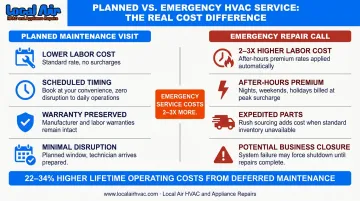
A 2018 Purdue simulation of rooftop units with accumulated faults found that reactive or emergency-style maintenance strategies produced lifetime operating costs 22% to 34% higher than optimal maintenance benchmarks.
The gap comes from three compounding factors: energy penalties that grow over time, more frequent part failures, and the premium pricing emergency service commands.
Emergency HVAC calls — after-hours labor, expedited parts, rush logistics — typically cost two to three times what the same repair would cost during a planned visit. That multiplier is the real financial argument for staying on a scheduled maintenance program.
How to Get the Most from Your Commercial AC Maintenance
Consistent, documented service delivers the most value. One-time tune-ups help in the short term but don't protect the asset or support warranty compliance over time.
Minimum service frequency for South Florida:
- Most commercial systems: twice per year (spring and fall)
- High-demand environments (restaurants, medical offices, buildings with extended hours): quarterly
What a quality maintenance visit should include:
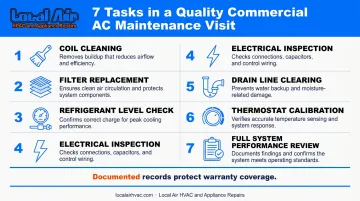
- Coil cleaning — both evaporator and condenser
- Filter replacement — inspect and replace based on loading, not just calendar
- Refrigerant level check — verify charge, test for leaks
- Electrical inspection — tighten connections, test capacitors and contactors
- Drain line clearing — flush the condensate line and verify the P-trap
- Thermostat calibration — confirm setpoints and operation
- Full system performance review — record supply and return temps, verify airflow, document findings
Documentation matters. Written service records support warranty compliance and give facility managers a clear picture of system condition over time — useful when making repair-versus-replace decisions.
When choosing a provider, look for EPA Universal Certification — it confirms proper refrigerant handling — along with a clear record of documented service visits. Local Air HVAC and Appliance Repairs has been serving commercial properties across Boca Raton, Delray Beach, Boynton Beach, and the surrounding South Florida area for over 20 years. That depth of local experience matters in South Florida's climate, where systems run harder and longer than in most of the country.
Conclusion
Commercial AC maintenance isn't an optional line item for South Florida businesses. It's what keeps energy costs predictable, extends the life of major capital equipment, and maintains the indoor conditions that employees and customers expect.
The benefits compound over time. A business that maintains its system consistently avoids the reactive spending cycle, protects its warranty coverage, and keeps occupants comfortable year-round. Deferring maintenance trades small planned expenses for large unplanned ones — and those failures rarely happen during slow periods.
Schedule maintenance before Florida's peak season, document every service visit, and work with technicians who understand what South Florida's heat and humidity actually demand from commercial equipment. Local Air HVAC has served Palm Beach County and surrounding commercial clients for over 20 years — EPA Universal Certified and equipped to keep your system performing when it matters most.
Frequently Asked Questions
How often should commercial AC systems be serviced in Florida?
Most commercial systems in Florida benefit from at least two scheduled maintenance visits per year, typically in spring and fall. High-demand buildings — restaurants, medical offices, facilities with extended operating hours — often warrant quarterly service given South Florida's year-round cooling load.
What does a commercial AC maintenance visit typically include?
A thorough visit typically includes:
- Coil cleaning and filter replacement
- Refrigerant level verification
- Electrical connection inspection
- Condensate drain line clearing
- Thermostat calibration and system performance assessment
Each task should be documented for warranty and budget planning purposes.
Can skipping commercial AC maintenance void my equipment warranty?
Yes. Most major manufacturers, including Carrier, explicitly exclude damage resulting from improper service or lack of documented maintenance. Skipping professional service can void warranty coverage and leave your business fully responsible for repair and replacement costs.
How does commercial AC maintenance actually lower energy bills?
Dirty coils, clogged filters, and low refrigerant force the system to work harder for the same cooling output. Purdue research on packaged commercial units found that fouling and airflow restriction reduce cooling efficiency by 12% or more — regular maintenance restores that lost efficiency directly.
What are the warning signs that a commercial AC system needs maintenance?
Common indicators include rising utility bills without a usage change, uneven temperatures across the building, unusual operating noises, increased indoor humidity, or a rise in occupant complaints. Any one of these warrants a professional inspection before the issue compounds.
Is commercial AC maintenance different from residential service?
Commercial systems are larger, more complex, and serve multiple occupants simultaneously — meaning a failure affects business operations, not just personal comfort. Service intervals, documentation, and technical scope are all more demanding than a standard residential tune-up.