Introduction
In South Florida, commercial air conditioning is infrastructure. Businesses in Boca Raton, Delray Beach, and the surrounding Palm Beach County area run their systems nearly every day of the year — Florida averages over 240 cooling days annually, more than almost any other state. That kind of continuous use places demands on equipment that most of the country never sees.
Neglecting that equipment has real consequences: premature system failure, energy bills that climb without explanation, refrigerant compliance issues under EPA regulations, and the particular pain of an emergency breakdown on the hottest day of August.
This guide covers what every South Florida business owner needs to know about commercial HVAC maintenance: why it matters, the four distinct types of maintenance, warning signs that something's wrong, and a practical service schedule built for Florida's year-round cooling demand.
Key Takeaways
- Energy-focused O&M programs can reduce commercial building energy costs by 5–20% — neglected systems waste far more
- There are four maintenance types: preventive, corrective, predictive, and major overhaul — most businesses need all four at different times
- Warning signs include uneven temperatures, unusual noises, ice on coils, and sudden energy spikes
- Florida's year-round cooling load means most commercial systems need service more than twice a year
- Refrigerant work must be handled by EPA Section 608-certified technicians — it's a legal requirement
Why Commercial HVAC Maintenance Matters
The Florida Load Problem
Commercial HVAC systems already work harder than residential units — longer operating hours, greater square footage, more occupants, more heat-generating equipment. In South Florida, that baseline is compressed further because the "off season" essentially doesn't exist.
Florida Climate Center data show the hot season begins as early as late March in southern stations, with the largest cooling degree-days in the country concentrated in this region. That translates directly to compressor run time, filter loading, refrigerant cycling, and wear on every mechanical component in the system.
Energy and Equipment Costs of Neglect
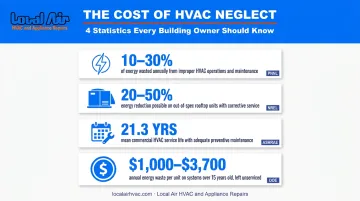
The cost of neglect shows up in two places: your energy bill and your equipment life. Research from PNNL, NREL, ASHRAE, and DOE's Better Buildings program makes the numbers concrete:
- HVAC accounts for the largest share of energy use in most commercial buildings — and 10–30% of that energy is wasted due to improper operations (PNNL)
- Rooftop units that fall out of spec can see 20–50% energy reductions from deep maintenance work (2025 NREL RTU Maintenance Guide)
- ASHRAE's service life database puts the mean removal age of packaged rooftop DX units at 21.3 years — but only with adequate maintenance
- Units over 15 years old frequently waste $1,000–$3,700 per unit annually in energy alone (DOE Better Buildings)
Safety and Refrigerant Compliance
Poorly maintained commercial systems don't just run inefficiently — they create genuine safety and legal exposure:
- Refrigerant leaks from corroded fittings or worn components release substances that are both environmentally harmful and federally regulated
- Cracked heat exchangers in gas systems introduce combustion gases into circulated air
- Electrical faults from dirty or loose connections create fire risk
The EPA requires that technicians who service equipment containing refrigerants hold Section 608 certification — a requirement that extended to HFCs as of January 1, 2018. Additionally, the AIM Act is phasing HFC production down to 15% of historic baseline by 2036. Any business running older systems needs a certified technician who understands current compliance requirements.
Local Air HVAC and Appliance Repairs holds EPA Universal Certification, covering refrigerant inspection and management as part of commercial maintenance visits.
Preventive vs. Reactive: The Cost Gap
The financial case for preventive maintenance comes down to timing. Catching a failing capacitor during a scheduled visit costs far less than the same part failing mid-July, triggering an emergency call, overtime labor, and potential cascade damage to connected components.
PNNL/FEMP data puts the savings from preventive over reactive maintenance at 12–18% on overall maintenance costs. Add predictive monitoring and that gap grows by another 8–12%. For a business running multiple units in South Florida heat, that difference adds up quickly.
Types of Maintenance for Commercial HVAC
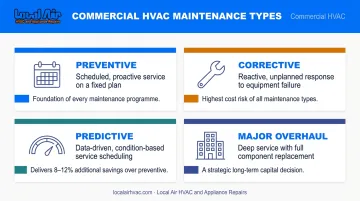
Commercial HVAC maintenance isn't one thing. Most businesses need a combination of all four approaches throughout the year.
Routine Preventive Maintenance
Preventive maintenance is scheduled, proactive service performed before problems appear. It's the foundation of any sound maintenance plan and the primary tool for controlling energy costs and extending equipment life.
Typical preventive maintenance tasks include:
- Air filter inspection and replacement
- Evaporator and condenser coil cleaning
- Refrigerant level check
- Condensate drain clearing
- Belt and motor inspection
- Electrical connection tightening
- Thermostat calibration
For systems in good condition, preventive maintenance is usually sufficient to maintain efficiency and catch developing issues early. In Florida's high-use environment, this means more frequent visits than the national minimum — which brings us to scheduling, covered in its own section below.
Corrective (Reactive) Maintenance
Corrective maintenance is unplanned: a capacitor fails, a refrigerant leak develops, a burned electrical connection kills the compressor. The repair happens in response to a failure rather than ahead of it.
The risk of relying too heavily on reactive maintenance is compounding damage. One failed component that goes undetected stresses adjacent parts. By the time a technician arrives for an emergency call, the original problem has often triggered secondary failures — and the repair bill reflects that.
Reactive maintenance is both unpredictable and consistently more expensive — a combination that erodes maintenance budgets fast. The real costs show up in three ways:
- Emergency labor rates: After-hours calls carry significant premium pricing
- Expedited parts sourcing: Rush orders for failed components add cost and delay
- Secondary failures: The original problem often damages adjacent parts before repairs begin
Predictive (Condition-Based) Maintenance
Predictive maintenance uses actual system data — refrigerant pressure readings, amperage draw, airflow rates, temperature differentials — to identify components trending toward failure before they actually fail.
Rather than servicing on a fixed schedule regardless of system condition, predictive maintenance targets repairs where the data says they're needed. This reduces unnecessary service visits while catching real problems early.
The Pacific Northwest National Laboratory (PNNL) estimates predictive maintenance delivers 8–12% savings beyond preventive maintenance alone. For larger commercial facilities, building control systems and smart thermostats make condition-based monitoring increasingly accessible.
Major Overhaul Maintenance
Major maintenance covers deep servicing or significant component replacement: coil replacement, compressor overhaul, ductwork resealing, or refrigerant system retrofit. This isn't routine — major overhaul makes sense when:
- Repair costs repeatedly approach or exceed a threshold relative to replacement value
- The system no longer meets current efficiency standards
- Refrigerant compliance requires a system conversion
- A building undergoes major renovation that changes load requirements
The decision between major overhaul and full replacement is worth careful analysis. U.S. Department of Energy (DOE) Better Buildings case studies show that strategic overhaul can reduce capital cost up to 30% compared to one-for-one replacement, while still delivering meaningful efficiency gains.
Warning Signs Your Commercial AC Needs Attention
Catching problems early prevents minor issues from becoming system-wide failures. These are the indicators that maintenance is overdue.
Performance and Comfort Changes
- Uneven temperatures across zones — some areas too warm, others fine — often points to clogged filters, low refrigerant, or duct leaks
- Longer run times to reach setpoints — the system is working harder to achieve the same result
- Spaces that never cool properly — particularly in corner offices or rooms far from air handlers
In a commercial setting, comfort problems have a direct business cost. Employee productivity and customer experience both suffer when temperatures drift, and in South Florida's heat, the gap between "functioning" and "struggling" is felt immediately.
Unusual Sounds, Smells, or Behavior
These aren't conditions to watch and wait on. Each one signals a system under strain that needs a technician, not a thermostat adjustment:
- Banging or rattling — loose components, possibly fan blades or motor mounts
- Hissing — refrigerant leak; a compliance issue as much as a performance one
- Grinding — worn bearings approaching failure
- Musty odors — mold growth in the drain pan or ductwork, common in Florida's humidity
- Short cycling — the unit turning on and off rapidly, stressing the compressor
Visible Wear and Rising Energy Bills
Beyond what you hear and smell, visual inspections reveal a separate set of problems. Look for these during regular walk-throughs:
- Corrosion on refrigerant lines or coil fins
- Water pooling near the unit (blocked condensate drain)
- Ice forming on the evaporator coil
- Error codes on the control panel
A sudden spike in energy bills without a change in occupancy or usage is one of the clearest operational signals. 10–30% of commercial building energy can be wasted through inefficient operation — and an unexplained utility increase almost always means the system is working harder than it needs to.
Commercial HVAC Maintenance Schedule
Maintenance frequency depends on system type, building size, usage intensity, and climate. Florida's year-round cooling season pushes most commercial properties past the national minimum of twice a year.
Recommended Service Framework
| Interval | Tasks |
|---|---|
| Daily/Weekly | Visual check for unusual sounds, thermostat settings, airflow obstructions |
| Monthly | Filter inspection or replacement (monthly during peak cooling per ENERGY STAR); condensate drain pan check |
| Quarterly | Coil cleaning, refrigerant level check, electrical inspection, belt and motor check |
| Annually | Full ductwork inspection, thermostat calibration, safety check, comprehensive performance assessment |
ASHRAE/ACCA Standard 180-2018 establishes quarterly air-handler filter accumulation checks as the minimum commercial standard. NREL's 2025 RTU Maintenance Guide uses the same quarterly, semiannual, and annual framework for rooftop units. Both treat this cadence as a baseline, not a best-case scenario.
Matching Schedule to Facility Type
- Low-usage offices (part-time occupancy, standard hours): biannual professional service may suffice
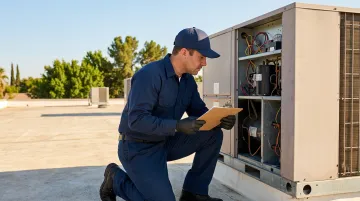
- High-use facilities (restaurants, medical offices, retail spaces, gyms running systems 12+ hours daily): quarterly professional visits are advisable in Florida's climate — mid-season breakdowns in these environments are especially costly
That cost risk is worth addressing proactively. Local Air HVAC's EPA Universal Certified technicians handle refrigerant inspection and management as part of scheduled commercial maintenance visits throughout Boca Raton, Delray Beach, Boynton Beach, and the surrounding South Palm Beach County area.
Conclusion
South Florida commercial HVAC systems run year-round, accumulate wear year-round, and fail at the worst possible times without consistent care. There's no off-season here — just months of continuous load on equipment that needs regular attention to keep performing.
The right approach combines routine preventive service, attention to warning signs, and a schedule calibrated to your building's actual usage — not just the calendar. EPA Universal Certified technicians handle the work that requires credentials: refrigerant checks, electrical inspections, and compliance with EPA regulations that carry real consequences if ignored.
If your commercial system hasn't been serviced recently, or you're not sure where it stands, contact Local Air HVAC and Appliance Repairs at 561-331-7633 to schedule a professional assessment. With over 20 years serving Palm Beach and the surrounding South Florida area, their team can evaluate your system and put together a maintenance plan built for the climate you're actually operating in.
Frequently Asked Questions
How often should a commercial HVAC system be serviced?
Most commercial systems need service at least twice a year, though ASHRAE/ACCA Standard 180 recommends quarterly maintenance as a baseline. High-use Florida facilities — restaurants, medical offices, retail spaces — typically benefit from quarterly visits given the year-round cooling demand.
What are the 3 R's of HVAC?
The 3 R's refer to Recover (removing refrigerant from a system into an external container), Recycle (cleaning recovered refrigerant for reuse by the same owner), and Reclaim (reprocessing refrigerant to AHRI Standard 700 specifications for resale). All three are EPA-regulated processes requiring certified technicians.
What is included in a commercial HVAC maintenance plan?
A standard visit covers filter replacement, coil cleaning, refrigerant level check, electrical inspection, thermostat calibration, condensate drain clearing, and belt and motor inspection. Scope varies by system type — high-load environments typically need more thorough coil and refrigerant attention.
What are the signs a commercial HVAC system needs immediate attention?
Urgent red flags: banging or hissing sounds, ice forming on the evaporator coil, water pooling near the unit, the system failing to maintain temperatures across zones, or a sudden unexplained spike in energy bills. These indicate active problems, not just deferred maintenance.
Does regular HVAC maintenance reduce energy and repair costs?
Yes. PNNL data shows energy-focused O&M programs reduce commercial building energy costs by 5–20%, and preventive maintenance saves 12–18% on overall maintenance costs compared to reactive repairs. For out-of-spec rooftop units specifically, deep maintenance can cut energy consumption by 20–50%.