Introduction
In South Florida, commercial HVAC systems don't get a break. Cooling runs from January through December, humidity rarely drops below uncomfortable, and the coastal air accelerates corrosion on equipment that's already working at capacity. When maintenance slips, the consequences hit fast: energy bills climb, air quality degrades, and breakdowns don't wait for convenient moments.
The stakes are higher than most business owners realize. According to the U.S. Department of Energy, heating and cooling account for roughly 35% of all building energy consumption — making HVAC one of the largest controllable operating costs on your books.
This guide covers:
- Why preventive maintenance matters financially and operationally
- The four types of maintenance every business should understand
- Warning signs to catch before they become emergencies
- A practical maintenance schedule built for South Florida conditions
- What to expect in terms of costs
Key Takeaways
- HVAC accounts for a major share of commercial energy costs — regular maintenance is the most direct way to control it
- Commercial systems fall into four maintenance categories: preventive, corrective, predictive, and major overhaul
- Warning signs include rising utility bills, uneven temperatures, unusual sounds or smells, and repeat breakdowns
- Most commercial systems need professional service twice yearly, plus monthly filter changes and quarterly checks for high-use facilities
- In Palm Beach County's coastal climate, coil cleaning and drain line inspections should happen more often than national averages recommend
Why Commercial HVAC Preventive Maintenance Matters
The Energy Cost Connection
A clean, calibrated HVAC system uses less energy to hit and hold its target temperature. A degraded one (clogged filters, fouled coils, low refrigerant charge) works harder, runs longer, and still delivers less comfort. That gap shows up directly on your utility bill.
The scale of this exposure is significant. EIA data shows commercial buildings spent 14% of their total electricity on cooling and 18% on ventilation in 2018. For a business with meaningful monthly energy costs, that's a line item that maintenance quality controls.
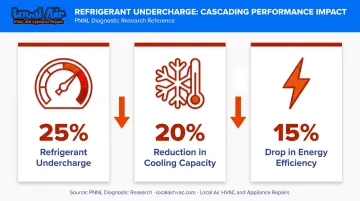
PNNL diagnostic research on commercial rooftop units found that a 25% refrigerant undercharge can reduce cooling capacity by 20% and cut energy efficiency by 15%. That kind of performance loss usually develops gradually and invisibly until someone notices the utility bills or the system stops keeping up on a hot afternoon.
Equipment Lifespan and Replacement Costs
ASHRAE's equipment service life data lists 15 years as the median estimated service life for single-zone and multizone commercial rooftop air conditioners. That's the benchmark for a properly serviced unit. Systems that run neglected (fouled coils, ignored refrigerant issues, deferred electrical checks) don't reach that mark.
Premature replacement is far more expensive than any maintenance contract. When a system fails at year 8 instead of year 15, you're absorbing replacement and installation costs years ahead of schedule, often on an emergency timeline that limits your equipment and vendor options.
Compliance Requirements
Commercial HVAC work isn't optional when it comes to certifications. EPA Section 608 requires that any technician who maintains, services, repairs, or disposes of equipment that could release refrigerants must hold EPA certification, passing an approved test covering their equipment type. Universal certification covers all refrigerant types.
Two ASHRAE standards frame what compliant maintenance looks like: Standard 62.1 sets ventilation and indoor air quality requirements for commercial buildings, while ASHRAE/ACCA Standard 180 defines minimum inspection and maintenance practices for commercial HVAC systems. These aren't just best-practice guidelines; they're the standards your system should be maintained against.
When hiring a contractor, confirm they hold EPA certification. Local Air HVAC and Appliance Repairs carries EPA Universal Certification, meaning refrigerant work is handled in compliance with federal requirements.
Safety Implications
A poorly maintained commercial system creates risks beyond discomfort:
- Mold growth in ductwork and drain pans — the EPA recommends keeping indoor relative humidity below 60% (ideally 30–50%) and drying wet areas within 48 hours to prevent biological growth
- Electrical faults from loose connections, worn insulation, or overloaded components
- Refrigerant leaks that affect air quality and trigger EPA reporting requirements for larger systems
- Fire hazards from operating without proper return-air filters, which Carrier's commercial service documentation explicitly warns against
Types of Commercial HVAC Maintenance
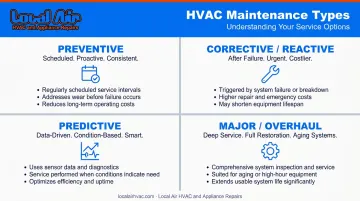
Not all maintenance serves the same purpose. A complete program for any commercial facility draws on all four types depending on system condition, age, and operational demands.
Preventive / Routine Maintenance
Scheduled, recurring service performed before failures occur — this is the foundation of any serious maintenance program.
Typical scope includes:
- Air filter replacement or cleaning
- Condenser and evaporator coil inspection and cleaning
- Electrical connection checks and tightening
- Refrigerant pressure and leak checks
- Lubrication of motors and moving parts
- Condensate drain and pan inspection
- Thermostat and control calibration
For well-functioning systems on a regular service schedule, preventive maintenance alone is often sufficient to sustain performance and lifespan. The DOE's operations and maintenance guidance reports that preventive programs can achieve 12–18% cost savings compared to reactive-only approaches — though that figure comes from legacy federal data and individual results will vary by system and facility.
Corrective / Reactive Maintenance
Every business ends up here occasionally: repairs made after a failure or visible performance problem has already occurred. The issue is when reactive work becomes the primary strategy.
Reactive maintenance costs more than planned service across almost every variable: emergency labor rates, after-hours callouts, parts sourced under pressure, and lost business during downtime.
Predictive / Condition-Based Maintenance
Data-driven service that identifies problems before they cause failure. Common inputs include:
- Energy consumption trends against historical baselines
- Sensor readings and fault detection alerts from building automation systems (BAS)
- Runtime pattern changes flagged for investigation
Large facilities with BAS infrastructure have the most built-in capability here. That said, any commercial operator can apply a practical version. A 10–15% unexplained jump in cooling costs warrants a service call — it rarely resolves on its own.
Major / Overhaul Maintenance
Deep-service interventions beyond what routine visits address:
- Compressor replacement or rebuild
- Full coil overhaul
- Professional ductwork inspection and cleaning
- Heat exchanger inspection
- Complete controls and sensor recalibration
This level of service becomes necessary when systems are aging (typically 8–12+ years), when routine maintenance is no longer holding performance, or when diagnostic results indicate widespread deterioration. It's also the appropriate response when the same components keep failing despite repeated repair.
Warning Signs Your Commercial HVAC System Needs Attention
Rising Energy Costs and Reduced Efficiency
Unexplained utility bill increases — without changes in occupancy, operating hours, or setpoints — almost always trace back to the HVAC system working harder than it should. Common culprits: clogged filters restricting airflow, fouled coils reducing heat transfer efficiency, or refrigerant issues cutting cooling capacity.
Uneven temperatures across zones or floors are a related red flag. If one area runs too warm while another is comfortable, the cause is typically airflow imbalance, duct leaks, a failing zone control, or a struggling unit that can no longer keep up.
Unusual Noises, Odors, or Operational Changes
Sounds to investigate:
- Banging or rattling — loose components or debris in the unit
- Squealing — worn belts or dry bearings
- Grinding — failing motor bearings
- Hissing — potential refrigerant leak
Odors to take seriously:
- Musty smell — mold or moisture in ductwork or the air handler (a particularly common issue in South Florida's humidity)
- Burning smell — electrical issue requiring immediate attention
- Gas odor — shut the system down and call for professional inspection
Visible Wear, Leaks, or Error Alerts
Physical signs worth acting on:
- Ice forming on coils or refrigerant lines
- Water pooling near indoor or outdoor units
- Visible corrosion on cabinet or coil fins
- Debris accumulation blocking outdoor unit airflow
- Thermostat error codes or BAS alerts appearing with increasing frequency
These aren't cosmetic issues. Ice on a coil signals refrigerant or airflow problems; water pooling points to a blocked condensate drain — a direct route to mold growth in humid climates.
Increasing Breakdown Frequency
A system that needs repair more than once or twice a year outside scheduled service — or that keeps failing at the same component — has outpaced what reactive fixes can address. The current maintenance approach isn't working.
Repeated temporary repairs on the same issue are a strong signal that either a major service is overdue or a replacement evaluation should be on the table.
Commercial HVAC Preventive Maintenance Schedule
Schedules vary based on system type, age, usage, and environment. A restaurant kitchen with heavy grease output needs more frequent filter and coil attention than a low-traffic office. In South Florida's coastal, humid climate, drain line checks and coil cleaning should happen more often than standard national guidelines — manufacturers and industry standards consistently call out monthly condenser coil cleaning for coastal and high-humidity environments.
| Frequency | Tasks |
|---|---|
| Daily | Monitor thermostat readings and zone temperatures; listen for unusual sounds; confirm outdoor units are unobstructed |
| Weekly | Visually inspect filters for visible debris; clear vegetation or debris from outdoor units; confirm drain pans are draining |
| Monthly | Replace or clean air filters; test thermostat calibration; inspect belts and pulleys; check condensate drain lines; coastal locations: clean condenser coils |
| Quarterly | Professional inspection and cleaning of condenser and evaporator coils; tighten electrical connections; test safety controls; lubricate motors; check refrigerant charge and inspect for leaks; inspect drain pans for biological growth |
| Semiannual | Inspect control systems, sensors, and variable-frequency drives; review performance trends against baselines |
| Annual | Full system performance evaluation; deep-clean all components; calibrate controls; test heat exchanger and combustion if applicable; professional ductwork inspection; complete safety audit |
Practical notes:
- High-usage operations (restaurants, medical facilities, 24/7 businesses) should move several quarterly tasks to monthly frequency
- Systems older than 10 years warrant more frequent professional inspections — ASHRAE 180 supports adjusting frequency when two successive inspections find unacceptable conditions
- Spring pre-season checks are essential before peak South Florida cooling demand hits; fall checks confirm the system is performing correctly even in months with minimal heating use
Conclusion
Commercial HVAC preventive maintenance isn't a line item to trim when margins tighten. Skipping it is how a system that should last 15+ years fails at year 8 — on a Friday afternoon in August, when you can least afford it. Treat it as a business continuity investment, not an optional expense.
For business owners across Palm Beach County and the surrounding South Florida area, working with a qualified local provider makes a practical difference. Local Air HVAC and Appliance Repairs has served the region for over 20 years and holds EPA Universal Certification — meaning refrigerant work is handled correctly and to code.
Whether your facility needs a structured maintenance plan, a pre-season readiness check, or a diagnosis on a system that's been running rough, reach the team at 561-331-7633.
Frequently Asked Questions
What is included in HVAC preventive maintenance?
Core tasks include filter replacement, condenser and evaporator coil cleaning, electrical connection inspection, refrigerant checks, lubrication of moving parts, thermostat calibration, and condensate drain and pan inspection. The full scope varies by system type, age, and how frequently service is performed.
How much does preventive maintenance cost for a commercial HVAC system?
Costs vary based on system size, number of units, access requirements, and contract scope. Annual service agreements generally cost less per visit than individual callouts, and preventive maintenance consistently runs below what reactive repairs and emergency callouts cost.
What are the 4 types of commercial HVAC maintenance?
The four types are preventive (scheduled recurring service), corrective/reactive (repairs after failure), predictive/condition-based (monitoring-driven service before failure), and major/overhaul (deep interventions like compressor replacement or full duct cleaning). A complete program draws on all four based on system condition and age.
How often should a commercial HVAC system be serviced?
Most commercial systems need professional service at least twice yearly — spring and fall — with monthly filter maintenance and quarterly inspections for high-usage facilities. Frequency increases with system age, usage intensity, and environmental conditions like coastal humidity.
How long do commercial HVAC systems last with regular maintenance?
ASHRAE data lists 15 years as the median estimated service life for commercial rooftop air conditioners. Systems that miss regular maintenance consistently fall short of that benchmark, often requiring costly premature replacement.
Do I need a certified technician for commercial HVAC maintenance?
Yes. EPA Section 608 requires certification for any technician handling refrigerants, and major tasks involving electrical systems, refrigerant, or safety components must be performed by a licensed professional. Basic tasks like filter swaps and visual checks can be handled in-house, but refrigerant work requires proper certification.