Introduction
Picture this: it's mid-July in Palm Beach County, temperatures are pushing 95°F, and your air conditioner stops working. You're now facing an emergency service call, a possibly days-long wait, and a repair bill that could easily run $350 to $2,000 — according to HomeAdvisor's 2025 repair cost data. A scheduled maintenance visit that might have caught the problem costs, on average, just $175 to $350.
Not every provider makes that cost difference worth it. Missed issues, voided warranties, and technicians unfamiliar with Florida's specific climate conditions turn maintenance visits into money spent on problems deferred rather than solved.
This guide covers what HVAC preventive maintenance actually includes, why Florida homeowners and businesses need it more than most, and exactly what to look for when choosing a provider you can rely on.
Key Takeaways
- Preventive maintenance means scheduled inspections, cleanings, and tune-ups that catch problems before they become failures
- Florida AC systems run 10–12 months per year — making maintenance more critical and more cost-effective than in cooler climates
- Verify EPA Section 608 certification and Florida state licensure before signing anything
- Ask every candidate provider what's included in each visit, how they handle emergency calls, and whether they provide written reports
- Local Air HVAC and Appliance Repairs offers 20+ years of Palm Beach-area experience and EPA Universal Certification on every maintenance visit
What Is HVAC Preventive Maintenance?
Preventive maintenance (PM) is scheduled, proactive service — inspections, cleanings, and adjustments performed on a regular basis to keep your system running before something breaks. It's the opposite of reactive repair, where you call someone only after the AC stops working.
ENERGY STAR frames it simply: routine maintenance prevents future problems and unwanted costs. The DOE puts it more bluntly — neglecting basic maintenance causes a steady decline in performance while energy use rises.
What a Standard Maintenance Visit Covers
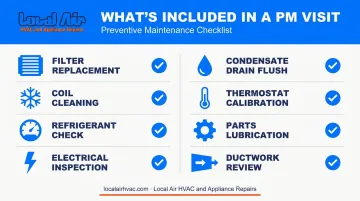
A properly scoped PM visit should include:
- Filter replacement or inspection — a clean filter alone can reduce energy consumption by 5–15%
- Evaporator and condenser coil cleaning — dirty coils force the system to work harder
- Refrigerant level check — low charge is a leading cause of compressor stress
- Electrical connection inspection — loose connections cause failures and safety hazards
- Condensate drain flush — blocked drains cause water damage and mold growth
- Thermostat calibration — ensures accurate temperature control
- Lubrication of moving parts — reduces motor wear
- Ductwork and airflow review — identifies leaks or restrictions
Why the Benefits Actually Matter
When those tasks get done consistently, the results show up on your energy bills and your equipment's lifespan:
- Lower energy bills — well-maintained systems run more efficiently
- Fewer emergency calls — problems are caught when they're minor, not critical
- Longer equipment life — ENERGY STAR recommends considering replacement when AC systems exceed 10 years; regular maintenance extends how long you can hold that off
- Better indoor air quality — clean coils and ducts reduce biological growth and allergen load
For Florida homeowners and commercial property managers, the stakes are concrete: a predictable maintenance budget versus an expensive surprise in the middle of August.
Why HVAC Preventive Maintenance Matters More in Florida
Most of the country runs their air conditioner for three or four months a year. Florida runs it for ten to twelve. That's not a minor difference: it's double or triple the wear on every component in your system.
96% of Florida homes use air conditioning, compared to 89% nationally. Florida households also spend roughly 40% more on electricity than the national average, and air conditioning accounts for 27% of household energy use in Florida — more than four times the national share.
That sustained load has real consequences when maintenance gets skipped.
The Three Florida-Specific Threats
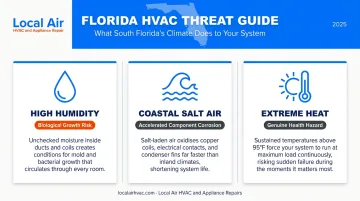
High humidity creates biological growth risk. Florida's climate creates ideal conditions for mold and mildew inside ductwork and on evaporator coils. The Florida DOH recommends keeping indoor humidity below 60% (ideally below 50%) to control mold growth. Without regular coil cleaning, a year-round HVAC system becomes a distribution path for biological contaminants.
Coastal salt air corrodes components faster. Palm Beach County's proximity to the Atlantic means salt spray is a constant hazard for HVAC coils. Salt corrosion is well-documented in coastal environments and accelerates component degradation. Systems within a few miles of the coast can show coil deterioration years ahead of schedule without protective maintenance.
Heat is a genuine health risk here, not just a comfort issue. Florida DOH data shows nearly 19,000 heat-related illness cases treated in Florida hospitals and emergency departments over a five-year period. The CDC specifically advises that air-conditioned spaces are the primary protection during extreme heat, especially for older adults.
For businesses, a system failure adds disruption, liability, and potential regulatory problems on top of the health concern.
What Skipped Maintenance Looks Like in Practice
Without regular service, Florida HVAC systems are at elevated risk of:
- Refrigerant leaks from corroded or stressed components
- Frozen evaporator coils from restricted airflow or low refrigerant
- Compressor failure from overworking in high-heat conditions
- Mold growth in air handlers and ducts
Every one of these failure modes is preventable with scheduled maintenance. None of them are cheap to fix once they've occurred.
What to Look for in an HVAC Preventive Maintenance Provider
Not all HVAC contractors are equal in credentials, scope, or reliability. The following criteria help you connect a provider's qualifications to real outcomes: system uptime, controlled costs, and longer equipment life.
Licensing and Certifications
Start with two credentials that aren't optional.
EPA Section 608 certification is required by federal law for any technician handling refrigerants (including the HFCs in modern systems like R-410A). Without it, a technician cannot legally work with refrigerants, and any work they perform may void your equipment warranty.
EPA Universal certification means a technician has passed exams covering all refrigerant types and equipment categories.
Florida state HVAC licensure is required to legally perform HVAC work in Florida. The state issues Certified Air Conditioning Contractor licenses in Class A, B, and C categories. You can verify any contractor's license through the Florida DBPR's online license verification portal. The DBPR's most recent unlicensed activity report documented nearly 2,000 legally sufficient construction industry complaints in a single fiscal year : unlicensed work is a genuine and common problem, not a theoretical one.
Ask to see both credentials before signing anything. A legitimate contractor will have no hesitation providing them.
Experience and Local Reputation
Years in business matter because HVAC in Florida isn't generic HVAC. A contractor who has worked in Palm Beach County for a decade or more understands humidity-driven coil degradation, coastal corrosion patterns, and the demand spikes that hit every summer.
An out-of-area or newly established provider may miss issues that a local veteran catches on instinct. Local reputation backs that up. Check Google reviews and ask for references from properties similar to yours (residential or commercial). Look for patterns across reviews, not just the star rating: consistent mentions of punctuality, honest diagnosis, and clear communication are better signals than a handful of glowing testimonials.
Scope of Services and Emergency Response
A full-service maintenance provider covers more than breakdown repairs. Confirm that any service agreement explicitly covers:
- Inspections and tune-ups on a defined schedule
- Filter and component replacement
- Coil cleaning and drain line service
- Written system reports after each visit
On emergency availability, ask two specific questions: What is your response time for an emergency? and Are you available outside normal business hours? A provider who can't give a clear, direct answer to both is signaling something important.
Transparent Pricing
A reliable provider gives you a written maintenance plan with defined scope, visit frequency, parts coverage, and total cost before you agree to anything. Compare at least two or three providers and ask for itemized estimates.
According to Angi's 2026 data, HVAC maintenance averages around $250 per visit nationally, with service contracts typically running $150–$300 per year. If a quote is well below that range, ask what's excluded. Hidden exclusions in service agreements are a common source of dispute.
Questions to Ask Before You Sign
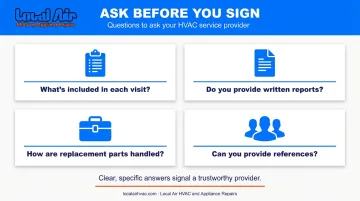
Use this list in your initial conversation:
- What exactly is included in each maintenance visit?
- Do you provide written reports after each visit?
- How are replacement parts handled — included in the contract or billed separately?
- Can you provide references from customers with similar systems or properties?
How a contractor handles these questions is itself useful information. Clear, patient, specific answers indicate a trustworthy partner. Vague or deflective responses are a warning sign before any work begins.
How Local Air HVAC and Appliance Repairs Can Help
Local Air HVAC and Appliance Repairs has served Palm Beach-area homeowners and businesses for over 20 years — long enough to have seen the full range of what Florida's climate does to HVAC systems and what prevents it.
Their credentials map directly to the selection criteria above:
- EPA Universal Certified technicians handle all refrigerant types legally and safely, keeping your equipment warranty intact
- 20+ years serving Palm Beach County means real familiarity with local humidity, coastal conditions, and seasonal demand
- Named Best Appliance Repair in Royal Palm Beach for 2024 (Quality Business Awards) — third-party confirmation of consistent service quality
- Customer satisfaction guaranteed on every visit
Beyond standard maintenance, Local Air offers complementary services that strengthen any PM program:
- UV light installation — reduces mold and bacteria growth inside air handlers
- Duct cleaning — restores airflow and improves indoor air quality
- Dryer vent cleaning — reduces fire risk and keeps energy use in check
Residential maintenance visits are structured for approximately 90 minutes; commercial visits allow two hours for more complex systems — both performed on-site at your property.
To schedule a preventive maintenance visit or ask about service plans for your Palm Beach-area home or business, contact Local Air HVAC at 561-331-7633. In a Florida summer, a skipped tune-up rarely stays cheap for long.
Conclusion
The right HVAC preventive maintenance provider isn't simply the nearest or cheapest option. It's the contractor who holds proper EPA and Florida state certifications, understands what the climate actually does to mechanical systems here, and communicates honestly about pricing and scope. They show up on schedule — before something breaks, not after.
Preventive maintenance is an ongoing partnership, not a one-time transaction. Revisit your maintenance schedule annually. Reassess your provider relationship if responsiveness or quality slips. Treat your HVAC system as the long-term investment it is — because in a Florida summer, a neglected system doesn't just cost you money. It fails on the hottest day of the year, when replacement parts are backordered and every other contractor in the county is already booked.
Frequently Asked Questions
What is the $5,000 rule for HVAC?
The $5,000 rule is a rule of thumb: multiply your system's age in years by the estimated repair cost, and if the result exceeds $5,000, replacement is often more cost-effective than repair. It's a useful starting point, not an official standard — a certified technician should evaluate each situation before you decide.
How often should HVAC preventive maintenance be done in Florida?
Most professionals recommend at least two visits per year — once before peak cooling season and once before winter. Florida's near-year-round AC usage often warrants more frequent service for older systems or high-use commercial properties where wear accumulates faster.
What is included in a typical HVAC preventive maintenance visit?
Standard tasks typically include:
- Filter replacement and airflow review
- Coil cleaning and refrigerant level check
- Electrical connection inspection and thermostat calibration
- Condensate drain flush and lubrication of moving parts
Exact scope varies by provider and should be confirmed in writing before the visit.
What certifications should I look for in an HVAC maintenance provider?
EPA Section 608 (Universal) certification is required by federal law for any technician handling refrigerants. Florida state HVAC licensure is separately required to perform HVAC work legally in the state. Both are verifiable through the DBPR's online license portal.
Is HVAC preventive maintenance worth the cost?
Yes. Annual maintenance averages $175–$350 nationally; a single repair call averages $350 and can reach $2,000 or more. ENERGY STAR identifies dirt and neglect as the top causes of HVAC failure — most of which scheduled service prevents.