The good news: most warm-air failures follow predictable patterns. Some you can fix in five minutes. Others require a licensed technician — and trying to handle them yourself can turn a $200 repair into a $2,000 one.
This guide walks you through the most common causes, what you can safely check right now, and when to stop troubleshooting and call a pro.
Key Takeaways
- The most common causes are a dirty filter, wrong thermostat setting, frozen evaporator coils, refrigerant leak, clogged outdoor unit, or compressor/electrical failure
- Filter and thermostat checks are free and take under five minutes — do these first
- Refrigerant, compressor, and electrical faults require a licensed, EPA-certified technician to diagnose and repair safely
- Delray Beach's heat makes this a same-day problem; if basic checks don't restore cooling within 30 minutes, call a professional
Common Reasons Your AC Is Blowing Warm Air in Delray Beach
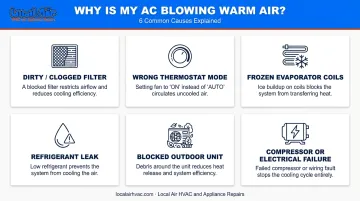
Most AC warm-air failures trace back to one of six causes. Delray Beach's year-round cooling demand and coastal salt air can accelerate all of them — filters clog faster, condenser coils corrode, and systems that run 10+ months a year wear components down faster than in cooler climates.
The six most common causes:
- Dirty or clogged air filter
- Thermostat set to the wrong mode or temperature
- Frozen evaporator coils
- Refrigerant leak
- Dirty or blocked outdoor condenser unit
- Compressor or electrical failure
Dirty or Clogged Air Filter
A clogged filter restricts airflow over the evaporator coil. Without adequate airflow, the coil can't absorb heat, and your vents push out warm or lukewarm air despite the system running continuously. This is the first thing to check — it costs nothing and takes two minutes.
ENERGY STAR recommends checking filters monthly during heavy-use periods and replacing at least every three months. In South Florida, where AC runs nearly year-round, monthly inspection is the practical standard. Coastal humidity causes airborne particles to clump and load filters faster than in dry climates — a filter that might last 90 days inland may need replacement in 30–45 days here.
Use a MERV 8–11 filter for most residential systems. Higher MERV ratings improve filtration but increase airflow resistance — only upgrade to MERV 13 if your system's fan can handle the added pressure drop.
Thermostat Set to the Wrong Mode or Temperature
Two settings cause this more often than people expect:
- Fan set to "ON" instead of "AUTO" — the blower runs constantly, pushing uncooled air through the vents between cooling cycles
- Mode set to "HEAT," "FAN ONLY," or "EMERGENCY HEAT" — especially common on heat pumps after a power interruption or battery swap
Before assuming a mechanical failure, confirm the mode reads "COOL," the fan is on "AUTO," and the set temperature is at least 2–3 degrees below the current room reading.
Frozen Evaporator Coils
Ice buildup on the evaporator coil blocks heat transfer entirely. The system keeps running, but warm or room-temperature air comes through the vents. Delray Beach's high humidity accelerates coil freezing when airflow is restricted or refrigerant is low, since moisture in the air freezes onto the coil rapidly.
If you suspect frozen coils, switch the system to fan-only mode and allow 1–2 hours to thaw. Do not chip or scrape ice off the coil. If freezing returns after thawing, the underlying cause (restricted airflow or low refrigerant) needs professional diagnosis.
Refrigerant Leak
Refrigerant absorbs heat from indoor air and carries it outside. When the charge drops due to a leak, the system can't complete the cooling cycle. Symptoms include:
- Hissing or bubbling sounds near the refrigerant lines
- Ice visible on the copper lines or the indoor unit
- Indoor temperatures that keep climbing despite the system running
Refrigerant handling requires EPA Section 608 certification — it is illegal for unlicensed individuals to purchase, add, or recover refrigerant. Topping off without finding and fixing the source of the leak only delays the failure.
Dirty or Blocked Outdoor Condenser Unit
The outdoor unit releases the heat pulled from inside your home. When the condenser coils are coated with dirt, leaves, or salt residue from Delray Beach's coastal air, the system can't release heat — and warm air backs up indoors.
Maintain at least two feet of clearance around the unit and rinse the coils periodically with a garden hose. According to ACHR News, salt exposure in coastal areas can damage finned coils and shorten equipment life considerably. Severely corroded coils require professional cleaning or coating — rinsing alone won't restore corroded fins.
Compressor or Electrical Failure
The compressor drives the refrigerant cycle. If it fails, the indoor fan keeps blowing without any cooling. Warning signs include loud clanking or grinding from the outdoor unit and a breaker that trips repeatedly.
Capacitor and contactor failures are more common than full compressor failure and less expensive to fix. Both prevent the compressor from starting and produce identical symptoms. A technician can test these components in minutes.
How to Troubleshoot Your AC Step by Step
Work through these steps in order. Starting simple saves you an unnecessary service call — and catches small problems before they become expensive ones.
Step 1: Check the Air Filter
Pull the filter and hold it up to light. If it's gray, compacted, or you can't see light through it, replace it immediately with a MERV 8–11 filter. Restart the system and check for cooling after 15 minutes.
Step 2: Check Thermostat Settings
Confirm:
- Mode is set to COOL
- Fan is set to AUTO
- Set temperature is at least 2–3 degrees below the current room temperature
- Replace batteries if the display is dim or flickering
Step 3: Inspect the Outdoor Unit
Head outside and check for the following:
- Condenser fan is spinning and running quietly
- No debris, leaves, or overgrown vegetation blocking the unit
- Ice on the copper refrigerant lines (a sign of a refrigerant or airflow problem)
Also check your breaker panel for a tripped breaker and reset it once only. If it trips again, stop — do not reset it a second time. A breaker that keeps tripping points to an electrical issue or compressor problem. Call a technician.
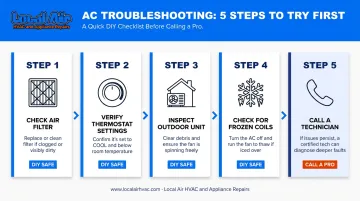
Step 4: Check for Frozen Evaporator Coils
If the indoor unit is running but producing no cooling, and you can see ice on refrigerant lines near the air handler:
- Turn the thermostat to fan-only mode
- Wait 1–2 hours for the ice to melt
- Restart in COOL mode and monitor
If freezing returns, the root cause requires professional diagnosis.
Step 5: Know When to Stop
Call a licensed HVAC technician if:
- None of the above steps restore cooling
- You hear hissing, gurgling, or grinding
- The breaker trips a second time
- You smell burning plastic or a chemical odor near the unit
- Indoor temperatures are climbing despite the system running continuously
When to Call a Professional Immediately
Some problems can't wait. With heat index values regularly exceeding 105°F in South Palm Beach County during summer, an unresolved AC failure can make interior spaces dangerous within hours, especially for elderly residents or young children.
Call immediately for any of these:
- Hissing or bubbling sounds near refrigerant lines or the outdoor unit
- Visible ice on refrigerant lines or the indoor unit
- A breaker that trips more than once
- The system running non-stop while indoor temperatures keep climbing
- A burning smell or chemical odor from the unit
Refrigerant repair, compressor diagnosis, electrical fault repair, and ductwork inspection all require a licensed, EPA-certified technician. EPA Section 608 certification confirms the technician has passed testing on refrigerant handling, recovery, and environmental regulations — a legal requirement for anyone who opens a refrigerant circuit.
Local Air HVAC and Appliance Repairs is EPA Universal Certified and has served Palm Beach County, including the Delray Beach area, for over 20 years. For same-day diagnosis, call 561-331-7633.
Should You Repair or Replace Your AC?
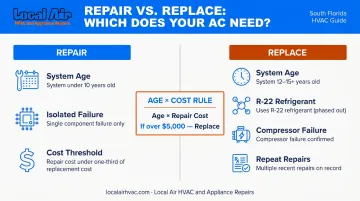
The decision comes down to three factors: system age, repair cost, and whether the fix addresses the root cause or buys time before a larger failure.
Repair makes sense when:
- The system is under 10 years old
- The issue is isolated — failed capacitor, clogged coil, refrigerant leak with a repairable source
- The repair cost is less than one-third the cost of a new system
Replace when:
- The system is 12–15+ years old
- It uses R-22 (production and import of HCFC-22 ended January 1, 2020 — servicing depends on recovered or stockpiled supply, making repairs increasingly expensive)
- It requires compressor replacement
- It has needed multiple repairs in the past 1–2 years
A useful benchmark: multiply the system's age by the repair cost. If the result exceeds $5,000, replacement is the better financial decision. For example, a 12-year-old system facing a $500 repair scores 6,000 — above the threshold.
Running costs matter too. An aging system that's lost efficiency often costs more monthly to run than a new one would cost to finance.
How to Prevent Your AC from Blowing Warm Air Again
Most warm-air calls are preventable. Three habits make the biggest difference in South Florida's climate:
- Replace filters on a regular schedule. Inspect monthly and swap them out at least every three months. Homes with pets or allergy sufferers should replace more frequently. With Delray Beach's cooling season stretching roughly 208 days, a clogged filter has a long runway to cause damage.
- Schedule a spring tune-up before peak season. Local Air's maintenance visits cover coil cleaning, refrigerant level checks, condensate drain flushing, and electrical component inspection. That level of attention catches a marginal capacitor or early refrigerant loss before it turns into a mid-July emergency.
- Keep the outdoor unit clear. Rinse condenser coils periodically with fresh water to remove salt deposits and debris. Trim vegetation to at least two feet of clearance on all sides. In coastal environments, salt air accelerates equipment wear — ask about corrosion-resistant coatings at your next maintenance visit. They meaningfully extend outdoor unit lifespan.
Frequently Asked Questions
Why is my AC blowing warm air in Delray Beach?
The most common causes are a dirty air filter, wrong thermostat setting, frozen evaporator coils, refrigerant leak, or outdoor condenser unit failure. Delray Beach's coastal humidity and year-round heat accelerate each of these issues — filters clog faster, coils corrode sooner, and systems that rarely get a break wear down quicker.
Can I fix my AC blowing warm air myself?
You can safely check the filter, thermostat settings, breaker, and outdoor unit for debris — those take minutes and cost nothing. Refrigerant leaks, compressor issues, and electrical faults require a licensed, EPA-certified technician, as refrigerant work is federally regulated under EPA Section 608 and cannot legally be performed without certification.
How often should I change my AC filter in Delray Beach?
Inspect monthly and replace every 90 days at minimum — ENERGY STAR and UF IFAS both recommend this for peak-season use. South Florida's humidity accelerates clogging, so use a MERV 8–11 filter and swap it early if it looks gray or compacted.
Why does my AC sometimes blow cold and sometimes blow warm air?
Intermittent cooling typically points to a failing capacitor, borderline-low refrigerant, or the outdoor unit overheating and cycling off on thermal protection before restarting. All three causes produce the same on-again, off-again symptom and all three require a technician to diagnose properly.
How much does AC repair cost in Delray Beach?
Trane notes that central AC repair costs can range from roughly $100 to over $5,000 depending on the problem, system age, parts, and labor. Get a diagnostic before authorizing any work — the diagnostic identifies the exact cause and prevents paying for parts that don't solve the problem.
How long can I safely run my AC if it's blowing warm air?
Don't run a system you know has a fault. A refrigerant leak or frozen coils stresses the compressor through overheating and lubrication failure — what starts as a $300 repair can escalate to a full compressor replacement. Shut it down and call a technician the same day.