The good news: warm air almost always has a specific, identifiable cause. Some you can fix in five minutes. Others require a certified technician. Knowing which is which saves you time, money, and a very sweaty afternoon.
Key Takeaways
- Warm air is usually caused by a wrong thermostat setting, clogged filter, refrigerant leak, blocked condenser, or electrical failure
- Thermostat issues and dirty filters are DIY fixes; refrigerant leaks and compressor failures require a licensed technician
- Running a failing AC worsens damage — a leaky refrigerant line can eventually burn out the compressor entirely
- Monthly filter checks and annual professional tune-ups prevent most warm-air problems
Common Causes of Your AC Blowing Warm Air
Warm air from your vents means one part of the cooling process has broken down. The cause could be a setting someone accidentally changed, or it could be a mechanical failure developing over weeks. Starting with the simplest, most accessible causes gets you to the answer fastest.
Incorrect Thermostat Settings
Check this first. It's the most common and most fixable cause.
If the fan is set to "On" instead of "Auto," the blower runs continuously — including between cooling cycles — pushing unconditioned air through your vents. According to Carrier's AC troubleshooting guidance, this is one of the most frequently overlooked warm-air causes.
Quick check:
- Confirm the mode is set to "Cool," not "Heat" or "Fan Only"
- Set the target temperature at least 5 degrees below the current room temperature
- Switch the fan setting from "On" to "Auto"
- Replace thermostat batteries if it's been more than a year
This issue is particularly likely after winter, when someone may have switched the system over without resetting all the settings. If the settings look correct but the problem persists, the thermostat may be miscommunicating with the system — a technician can recalibrate or replace it quickly.
Dirty or Clogged Air Filter
A severely clogged filter starves the system of airflow. Without adequate airflow, the evaporator coil can't absorb heat properly, which causes the system to either overheat or freeze up — both result in warm or no air from the vents.
ENERGY STAR recommends inspecting your filter monthly for central AC systems, and the DOE echoes this, noting filters may need more frequent changes under constant use or dusty conditions. In Florida's year-round cooling climate, monthly checks are a reasonable baseline.
DIY fix:
- Turn the system off
- Remove the filter and hold it up to a light source
- If light doesn't pass through clearly, replace it
- Restart the system and check airflow within a few minutes
If warm air continues after replacing the filter, the restricted airflow may have already frozen the evaporator coil. Turn the system off for a few hours to let it thaw before running it again.
Low Refrigerant or a Refrigerant Leak
Refrigerant absorbs heat from your indoor air — it's what makes cooling possible. When levels are low because of a leak, the system can't complete that heat exchange, and room-temperature or warm air comes out of the vents.
One important distinction: refrigerant doesn't deplete through normal use. Low levels always mean a leak.
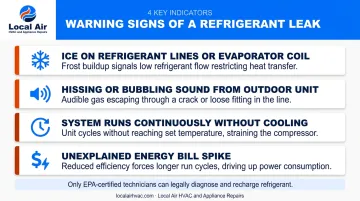
Signs to watch for:
- Ice forming on the refrigerant lines or evaporator coil
- A hissing or bubbling sound from the outdoor unit
- The system running continuously without the house temperature dropping
- Noticeably higher energy bills without a change in usage
EPA Section 608 regulates refrigerant handling, and only EPA-certified technicians can legally diagnose leaks, repair refrigerant lines, and recharge systems. Attempting this without certification is illegal and unsafe. Local Air HVAC and Appliance Repairs holds EPA Universal Certification — the broadest credential level — covering all residential and commercial equipment types.
Dirty or Blocked Outdoor Condenser Unit
The outdoor unit's job is to release the heat pulled from inside your home. When it's packed with leaves, grass clippings, or dirt — common in Florida's outdoor environment — it can't dissipate heat effectively. The result: the system struggles to cool and eventually blows warm air indoors.
The DOE recommends keeping vegetation trimmed back at least two feet from the condenser on all sides for adequate airflow.
Basic DIY cleaning:
- Turn the system off completely
- Clear debris from around and on top of the unit
- Rinse the exterior coils gently with a garden hose — low pressure, working from the inside out if possible
- Avoid bending the aluminum fins
If the unit is heavily caked with grime or the fins are visibly bent, schedule a professional coil cleaning. Local Air includes condenser coil cleaning as part of its maintenance service — a professional clean reaches grime a garden hose can't and avoids accidental fin damage.
Electrical Issues and Compressor Failure
If the indoor air handler is running but the outdoor unit is completely silent, the outdoor unit has lost power.
Start here:
- Check your electrical panel for a tripped breaker labeled "AC" or "HVAC"
- Reset it once
- If it trips again immediately, stop — do not reset it a second time
A breaker that keeps tripping points to an underlying electrical or mechanical problem, often involving the compressor. The compressor circulates refrigerant through the entire system — when it fails, cooling stops entirely. That pattern of symptoms warrants a diagnostic call, not another reset.
Signs of compressor trouble:
- Grinding or clicking sounds from the outdoor unit
- The unit tries to start but shuts off immediately
- The breaker trips repeatedly
Compressor repair or replacement is one of the most costly HVAC fixes. Carrier notes that most central AC systems last 15 to 20 years, and a failing compressor on an older system often prompts a full system evaluation rather than repair alone.
What Happens When You Ignore Warm Air
Running a struggling AC doesn't buy you time — it makes the underlying problem worse and more expensive.
Three warning signs you're already in deeper trouble:
- Constant running without cooling means the unit is overworking every component, accelerating wear across the board.
- Unexplained energy bill spikes signal the system is drawing extra power trying to compensate — money spent on a system that isn't working.
- Ice on the lines or water pooling near the air handler points to airflow or refrigerant problems that, left alone, cause water damage and mold inside the unit or your walls.
The biggest financial risk is the compressor. Running a system with a known refrigerant leak forces it to operate under abnormal conditions, and what starts as a manageable leak repair can escalate into full compressor failure.
That means turning a few hundred dollars into a much larger bill — or a full system replacement. Per the DOE, neglected maintenance directly leads to increased energy use and declining performance. A service call now costs far less than a compressor replacement later.
How to Prevent Your AC from Blowing Warm Air
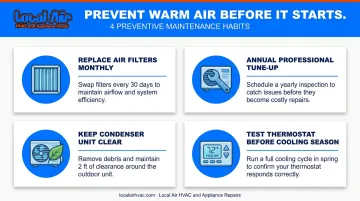
Most warm-air emergencies are preventable. These four habits, consistently followed, eliminate the most common causes before they become service calls.
Replace Air Filters on Schedule
Check the filter monthly during Florida's long cooling season (roughly March through November) and replace it at minimum every one to three months, or sooner if it's visibly dirty.
A clean filter keeps airflow moving through the system, preventing the frozen coils, overheating, and efficiency loss that a clogged filter triggers. For most homeowners, it's also the cheapest maintenance step with the biggest payoff.
Schedule an Annual Professional Tune-Up
ENERGY STAR recommends annual pre-season professional maintenance, with cooling systems checked each spring. A proper tune-up covers everything DIY checks can't safely address: refrigerant levels, electrical components, coil cleaning, condensate drain care, and full system performance.
Local Air HVAC and Appliance Repairs, serving Boca Raton, Royal Palm Beach, and surrounding South Palm Beach County communities for over 20 years, covers all of this in their maintenance visits: refrigerant and electrical checks, coil cleaning, and condensate drain service. Catching a worn capacitor or a developing refrigerant leak in April is a very different situation than discovering it in August.
Keep the Outdoor Condenser Unit Clear
Trim vegetation at least two feet back from all sides of the unit and rinse the exterior coils with a garden hose after storms or lawn work. Unobstructed airflow lets the condenser release heat properly. Even partial blockage forces the system to work harder and shortens its lifespan.
Test the Thermostat Before Cooling Season Starts
Before the first hot stretch of the year, set the system to "Cool," drop the temperature several degrees, and confirm cold air comes through within a few minutes. Replace the batteries while you're at it. An ENERGY STAR-certified smart thermostat can also help, with average savings of approximately 8% on heating and cooling bills, or about $50 per year.
Tips for Long-Term AC Health
A few additional habits that catch problems before warm air ever appears:
- Pour a cup of diluted white vinegar into the condensate drain access point monthly — this prevents clogs that trigger automatic shutoffs
- Keep supply and return vents clear of furniture, curtains, and rugs — blocked return vents are a leading cause of frozen coils and reduced cooling
- Pay attention to hissing, clicking, grinding, musty odors, or burning smells — these usually signal a developing problem before performance drops
- Keep a simple maintenance log of filter changes, service visits, and any odd behavior — it helps technicians diagnose recurring issues faster and supports warranty documentation
Conclusion
An AC blowing warm air in a Florida home is a solvable problem — and in most cases, the cause is one of a short list of identifiable culprits. Whether it's a thermostat setting someone bumped, a filter that's overdue for replacement, or a refrigerant leak that needs a certified technician, catching it early keeps a minor fix from turning into a full system replacement.
Combine the DIY checks in this guide with an annual professional tune-up, and you eliminate the most common causes before they show up on a 90-degree afternoon. For anything beyond a filter swap or thermostat adjustment — especially refrigerant issues, compressor concerns, or electrical problems — call a certified technician.
Local Air HVAC and Appliance Repairs has been handling exactly these issues for South Palm Beach County homeowners for over two decades. Reach them at 561-331-7633.
Frequently Asked Questions
Why is my AC suddenly blowing warm air?
Sudden warm air usually means something changed fast: a tripped breaker cutting power to the outdoor unit, a thermostat accidentally switched to "Heat," or a refrigerant leak that's reached a critical point. Check your thermostat settings and electrical panel first to rule out the simplest causes before calling a technician.
What is the 3-minute rule for AC?
The 3-minute rule refers to waiting at least 3 minutes after turning off your AC before restarting it. This allows suction and discharge pressures to equalize, so the compressor starts under normal load rather than under excessive pressure — which can cause damage or trip the breaker.
Can a dirty air filter cause my AC to blow warm air?
Yes. A severely clogged filter restricts airflow enough to prevent the evaporator coil from absorbing heat properly. This can cause the coil to freeze or the system to overheat, both of which result in warm or no air from the vents. Replacing the filter is the first thing to check.
How do I know if my AC is low on refrigerant?
Common signs include ice on the refrigerant lines or evaporator coil, a hissing or bubbling noise from the outdoor unit, or the system running non-stop without cooling the house. Only an EPA-certified technician can confirm low refrigerant and legally perform a recharge.
Should I turn off my AC if it's blowing warm air?
Yes — if you see ice on the unit or lines, hear unusual sounds, or the breaker keeps tripping, shut it off. Running under those conditions risks burning out the compressor and turning a fixable problem into a far costlier one.
How often should I schedule professional AC maintenance?
At minimum once a year, ideally in spring before peak cooling season. In Florida, where AC systems run nearly year-round, a second maintenance visit in fall — after the heavy summer usage period — helps catch wear before it develops into a breakdown.