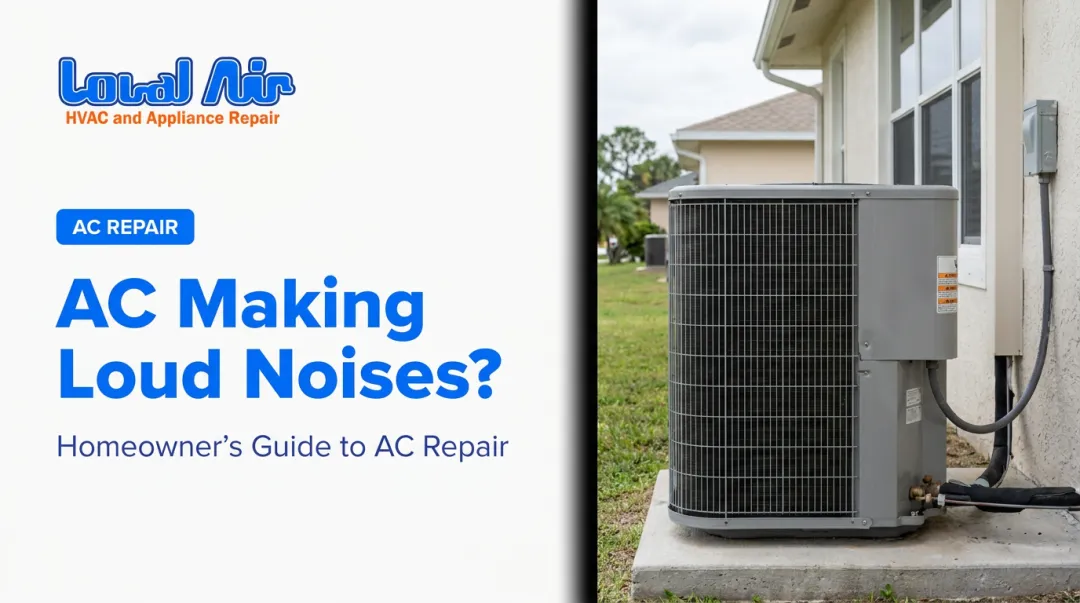
When your AC starts making a noise it didn't make before, that's not background noise — it's a signal. Different sounds point to different problems, and knowing the difference can mean catching a $250 capacitor before it becomes a $1,200 compressor replacement.
This guide covers the most common AC noises in Palm Beach County homes, what each one means, when to shut the system off immediately, and how to prevent these problems from coming back.
Key Takeaways
- Every unusual AC noise points to a specific cause — banging, buzzing, hissing, screeching, and rattling each signal different components
- Some noises are emergencies: hissing near refrigerant lines, loud banging, and persistent screeching mean shutting the unit off immediately
- Florida's heat and humidity wear down AC components faster than most climates, making routine maintenance especially important here
- Annual tune-ups, monthly filter checks, and clearing debris from the outdoor unit prevent most noisy AC problems
- Call a technician when unsure: AC systems involve pressurized refrigerant and high-voltage components that aren't safe to DIY
Common AC Noises and What They Mean
AC units produce normal operational sounds — the whoosh of airflow, a soft hum from the compressor, a click when the thermostat cycles the system on and off. What falls outside that range matters. Each unusual noise type acts as a diagnostic clue pointing to a specific component or system failure.
Banging or Clanking
A banging or clanking sound — especially at startup — typically means something has come loose or broken inside the unit. Common culprits include a loose or unbalanced blower fan blade, worn-out motor mounts that allow components to shift during operation, or a failing compressor.
ACHR News describes a loud compressor caused by a scroll compressor running backward as capable of causing significant damage if the system isn't shut off immediately.
What to do: Turn the unit off at the thermostat. Don't restart it hoping the noise goes away — parts striking each other repeatedly cause accelerating damage. Call a technician.
Buzzing or Humming
A buzzing noise from the outdoor unit often points to electrical issues:
- Failing capacitor struggling to start the compressor or fan motor
- Faulty contactor relay — Sprecher+Schuh's technical documentation confirms that buzzing or humming from a contactor indicates coil voltage problems, insufficient current, or debris preventing proper seating
- Loose wiring that vibrates during operation
A loud hum from the indoor unit may mean the blower motor is straining or that evaporator coils have frozen. ACHR News reports that dirty filters restrict airflow, drop suction pressure, and can cause coil ice — which in turn strains the blower motor and can lead to refrigerant floodback that damages compressor components.
If the buzz is sudden, loud, or paired with reduced airflow or a no-start condition, turn the system off at both the thermostat and the circuit breaker.
Hissing or Bubbling
A steady hissing near the indoor unit or refrigerant lines almost always signals a refrigerant leak. Pressurized refrigerant escaping through cracks or damaged components produces a distinct, high-pitched hiss. A bubbling or gurgling sound means liquid refrigerant is escaping at the same location.
Trane's guidance on refrigerant leaks confirms that running the system with a leak causes further damage and environmental harm. Left unaddressed, a refrigerant leak leads to:
- Reduced cooling capacity
- Higher electric bills
- Increased indoor humidity
- Eventual compressor failure
EPA Section 608 regulations require that only certified technicians handle refrigerant repair and recharge. Local Air HVAC and Appliance Repairs holds EPA Universal Certification, covering all refrigerant types used in residential and light-commercial systems — including older R-22 and newer R-410A — common throughout Palm Beach County.
Screeching or Squealing
High-pitched screeching is typically metal-on-metal friction from worn fan motor bearings that have lost lubrication. In older belt-driven units, a damaged or slipping belt produces a similar squeal.
Shut the system off immediately if the screeching is coming from the compressor area. A technician can catch bearing wear during a routine maintenance visit and re-lubricate or replace the component before it turns into a costlier repair.
Rattling or Clicking
Rattling is usually one of two things:
- Debris (palm seeds, leaves, twigs) inside the outdoor condenser striking the fan blades — common in Florida after wind or storms
- Loose screws, panels, or fan blades vibrating during operation
Clicking is more nuanced. A single click when the system starts and stops is normal — that's relay switches engaging. Persistent clicking throughout a cycle, however, often points to a failing thermostat, a bad relay switch, or a malfunctioning capacitor. RepairClinic identifies repetitive clicking as a possible sign of a malfunctioning thermostat or defective contactor.
For rattling: power off the outdoor unit at the disconnect box and visually inspect for debris. If it's debris-free and the noise continues, professional diagnosis is needed.
What Happens If You Ignore a Noisy AC
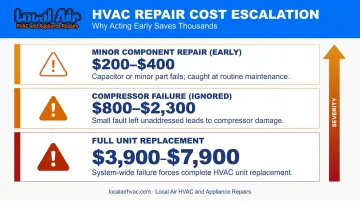
A loose component or worn bearing caught early typically means a $200–$400 capacitor replacement. Left alone, the same underlying problem can escalate to compressor failure — which runs $800 to $2,300 on average, according to HomeAdvisor 2025 data, and sometimes exceeds the cost of replacing the entire unit ($3,900–$7,900 for full central AC replacement).
In Palm Beach County, the comfort stakes are higher than in most parts of the country. An AC failure during a South Florida summer isn't just inconvenient — it's a health risk. The CDC identifies older adults, infants, children, and people with chronic conditions as most vulnerable to heat-related illness, and lists lack of air conditioning as a direct risk factor.
Florida DOH data from 2005–2009 recorded over 18,000 Floridians treated for non-occupational heat-related illness, with 53 deaths among treated cases.
Florida's ambient humidity compounds the problem further. A failing AC allows indoor moisture to spike rapidly, and the EPA recommends keeping relative humidity below 60% to prevent mold growth. In this climate, an idle AC can push past that threshold within hours.
Signs a noise is becoming critical:
- The sound is getting louder or more frequent
- The AC is running but not effectively cooling
- The system is short-cycling (turning on and off rapidly)
- Ice is visible on refrigerant lines or the indoor unit
- A burning smell accompanies the noise
Any of these combinations warrants turning the system off and calling a technician the same day.
How to Fix a Noisy AC: Immediate Steps
Step 1: Gather Information Before You Call
When you first notice an unusual noise, take note of:
- Whether the sound is coming from the indoor air handler or outdoor condenser
- What type of sound it is (banging, buzzing, hissing, screeching, rattling, clicking)
- When it occurs — at startup, shutdown, or continuously
- Whether cooling performance has changed
This information helps a technician diagnose the problem faster and arrive prepared.
Step 2: Know When to Shut It Off Immediately
Turn the unit off now if you hear:
- Loud banging or clanking
- Screeching from the compressor area
- Hissing near the refrigerant lines
- Persistent buzzing with the unit failing to start
You can briefly investigate if you hear:
- Rattling from visible outdoor debris
- A single click at startup or shutdown only
When in doubt, shut it off. The cost of running a stressed system for another day almost always exceeds the cost of the downtime.
Step 3: The Safe DIY Checks
There are two things homeowners can safely check themselves:
- Outdoor debris — Power off the outdoor unit at the disconnect box, then visually inspect the condenser grille for leaves, twigs, or debris. Remove any visible obstructions.
- Indoor air filter — A clogged filter can cause frozen coils and blower motor strain. Pull the filter and replace it if it's visibly dirty.
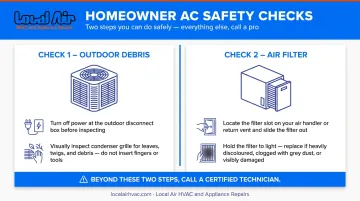
Beyond these two checks, avoid DIY attempts on electrical components, refrigerant lines, or internal mechanical parts. Capacitors store lethal voltage even when the system is off. Refrigerant handling requires EPA certification.
Step 4: Call a Certified Local Technician
AC systems combine pressurized refrigerant, high-voltage electrical components, and precision-balanced mechanical parts. A certified technician can accurately identify the source of the noise and address it before minor damage becomes a costly repair.
Local Air HVAC and Appliance Repairs has served Royal Palm Beach, Boca Raton, Delray Beach, Boynton Beach, and communities throughout South Palm Beach and North Broward Counties for over 20 years. EPA Universal Certified and backed by a customer satisfaction guarantee, You can reach them at 561-331-7633 or book online through their website.
How to Prevent AC Noise Problems in the Future
Florida's climate means your AC runs nearly year-round. South Florida's summer season averages 152 days of heat and humidity according to NWS Miami, and the system barely rests outside that window. Components wear faster here than in cooler states, so prevention is the primary way to avoid both noise and major repair bills.
Schedule Annual Professional Maintenance
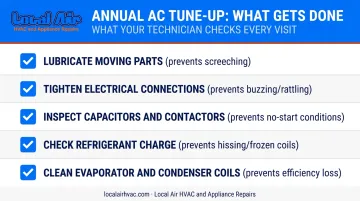
An annual AC tune-up catches the problems that produce noise before they get loud enough to notice. ENERGY STAR's maintenance checklist includes:
- Lubricating moving parts (prevents screeching from dry bearings)
- Tightening electrical connections and fasteners (prevents buzzing and rattling)
- Inspecting capacitors and contactors (prevents buzzing and no-start conditions)
- Checking refrigerant charge (prevents hissing and frozen coils)
- Cleaning evaporator and condenser coils (prevents strain and efficiency loss)
Schedule this in spring, before peak cooling season, so any issues are resolved before the system is running at full demand. Local Air's annual tune-ups cover all of these checkpoints — scheduled before the summer peak so nothing catches you off guard in July.
Replace Air Filters Regularly
A clogged filter is one of the most common causes of avoidable AC noise. Restricted airflow forces the evaporator coils to freeze, strains the blower motor, and can eventually cause refrigerant floodback that damages the compressor.
ENERGY STAR recommends inspecting filters monthly and replacing them as needed. In Florida — where systems run continuously and humidity keeps dust and particulates airborne — the practical standard is:
- Every month: Quick visual inspection (hold it up to the light)
- Every 1–3 months: Full replacement, depending on dust levels and pet traffic
- After any renovation: Replace immediately regardless of schedule
Keep the Outdoor Unit Clear of Debris
Florida's landscape produces a constant supply of condenser-clogging debris: palm seeds, Spanish moss, leaves, and twigs. After storms, the problem gets worse. The DOE recommends trimming vegetation back at least 2 feet from the outdoor unit on all sides. Check the condenser grille periodically and remove any debris that's accumulated inside.
Between your own checks, Local Air includes condenser and evaporator coil cleaning as part of its maintenance visits — helpful after a storm season that leaves debris packed into the unit.
Address Small Issues Promptly
A new noise caught early almost always costs less to fix than one ignored for two months. Build a habit of listening to your AC at startup — note any changes in sound, vibration, or how long it takes to cool the house. Those early signals are the cheapest time to act.
Conclusion
Unusual AC noises aren't random — every sound type has an identifiable cause, and most of those causes are fixable before they become system failures. Banging, buzzing, hissing, screeching, and rattling each point to specific components. Catching them early means the difference between a minor repair and a compressor replacement.
For Palm Beach County homeowners who rely on their AC year-round, the most reliable path to a quieter, longer-lasting system is straightforward: pay attention to new sounds, act on them quickly, and schedule annual professional maintenance before peak season. Local Air HVAC has been keeping South Florida systems running for over 20 years — a pre-season tune-up is the simplest way to avoid an August breakdown.
Frequently Asked Questions
Why does my AC sound so loud all of a sudden?
A sudden increase in noise usually means a component has recently failed or come loose. Common culprits include a failing capacitor, an unbalanced fan blade, debris entering the condenser, or the early stages of a refrigerant leak. Schedule an inspection promptly — sudden noise changes rarely resolve on their own.
How can I tell if my AC compressor is failing?
Watch for banging or clanking at startup, the outdoor unit running without cooling the home, repeated circuit breaker trips, or excessive vibration. Compressor failure is one of the costliest AC repairs, so call a professional as soon as these signs appear.
Is it safe to run my AC when it's making a loud noise?
That depends on the noise type. Rattling from minor debris may be safe to address briefly, but banging, screeching, and hissing indicate conditions that cause rapid further damage if the system keeps running. When in doubt, turn it off at the thermostat and call a technician.
What does a hissing AC sound like, and is it dangerous?
It sounds like a steady, high-pitched tone similar to air escaping a tire, sometimes paired with a bubbling noise. This signals a refrigerant leak that reduces efficiency and can damage the compressor — repairs require an EPA-certified technician.
Can a dirty air filter cause my AC to make noise?
Yes — a severely clogged filter restricts airflow, which can freeze the evaporator coils (producing buzzing or gurgling) or strain the blower motor into audible humming. Swapping in a clean filter is the simplest noise-prevention step you can take.
How much does it typically cost to fix a noisy AC?
Costs vary widely based on the cause. Capacitor replacement runs $200–$400 on average (Angi, 2026). Refrigerant leak repair ranges from $250–$1,600, averaging around $800 (Angi, 2026). Compressor replacement typically falls in the $800–$2,300 range (HomeAdvisor, 2025). Routine maintenance catches most of these problems early — before they become emergency calls.