Strange AC noises are among the most common service calls Local Air HVAC and Appliance Repairs responds to across Palm Beach County. And there's a reason: each sound type is effectively a diagnostic signal pointing to a specific failed or failing component. The noise isn't random.
Some of these sounds are low-urgency — a light rattle that's just a twig caught in the fan housing. Others mean shut the unit off immediately before a $400 repair becomes a $2,000 compressor replacement. This guide walks through what each common noise means, how to diagnose it yourself, and when to call a professional.
Key Takeaways
- Banging, grinding, and hissing are emergencies — shut the system off and call a technician today
- Buzzing, squealing, and clicking signal components starting to fail; schedule service within 48 hours
- Light rattling and whistling are often DIY-fixable with a filter swap or debris removal
- Matching the noise to the component helps you avoid costly misdiagnoses and unnecessary repairs
- Florida's near-constant AC runtime accelerates component wear; annual maintenance catches failures before they become emergencies
What Does a Normal AC Sound Like?
Knowing what "normal" sounds like is genuinely useful — it's your baseline for catching problems early.
A healthy central AC system produces:
- A low, steady hum from the compressor and outdoor fan motor
- A soft whoosh of air moving through vents when the blower kicks on
- A single click at startup and a single click at shutdown (the contactor engaging and disengaging)
According to Trane's published sound guidance, HVAC equipment should ideally register no louder than 60 dB inside the home. The outdoor condenser will naturally sound louder and more mechanical than the indoor air handler — that's expected.
When familiar sounds become noticeably louder, shift in character, or are replaced by something new (grinding, banging, screeching, hissing), something specific has changed inside the system. Pinpointing where the sound originates — indoor air handler, outdoor condenser, or ductwork — is the first step toward an accurate diagnosis.
Common AC Noises and What They Mean
Most AC noise problems follow predictable patterns. Each sound category maps to a specific type of failure — mechanical, electrical, or refrigerant-related. Here's what each one is telling you.
Banging or Clanking
What it sounds like: Loud thudding or clanking, often at startup or shutdown; may coincide with reduced cooling.
Likely cause: A loose or broken internal component — a detached blower wheel, a loose component inside the motor assembly, or a compressor under stress. Per ACHR News diagnostic guidance, thumping and vibrating often trace back to blower wheel or housing problems. A worn-out compressor can also produce loud, unusual noises.
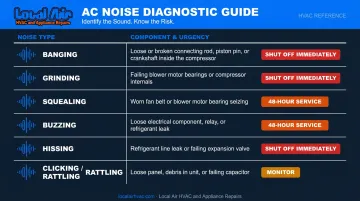
Urgency: High. Continued operation risks cascading damage.
Grinding or Scraping
What it sounds like: Metal-on-metal contact, continuous while the unit runs, often worsening over time.
Likely cause: A blower wheel loose from the motor shaft, a broken blower wheel, or a failed motor mount allowing the wheel to contact the housing. Left running, components will sustain serious damage fast.
Urgency: Critical. Turn the system off immediately.
Squealing or Screeching
What it sounds like: High-pitched screech on startup or during operation.
Likely cause: Failing motor bearings in the blower or condenser fan motor, or a worn blower belt in older systems. American Standard and Goodman both link high-pitched AC sounds to loose parts, worn bearings, and motor components needing attention.
Urgency: Moderate-to-high. Bearing wear progresses quickly — schedule service before it fails completely.
Buzzing or Humming (Louder Than Normal)
What it sounds like: An electrical buzz from the outdoor unit; the unit may struggle to start or short-cycle.
Likely cause: A failing capacitor is the most common culprit. ACHR News identifies overheating as a primary cause of capacitor failure — and in Palm Beach County's climate, where 90% of homes run central AC nearly year-round, capacitors take a beating. A buzzing transformer or a noisy fan motor are also possible sources.
Urgency: Moderate. A capacitor that's starting to fail will eventually fail completely — schedule service within 48 hours.
Hissing or Whistling
What it sounds like: Hissing from near the indoor or outdoor unit; whistling from vents.
Likely causes — two different problems:
- Hissing from the unit itself typically indicates a refrigerant leak. Trane identifies hissing near refrigerant lines as a likely leak indicator. Even a moderate leak reduces cooling efficiency — NIST research found a 20% refrigerant undercharge increases energy use by 8%.
- Health risk: Refrigerant exposure is a real concern. The NIOSH Pocket Guide for R-22 lists respiratory irritation, dizziness, and cardiac arrhythmia as inhalation effects.
- Whistling from vents usually signals restricted airflow from a clogged filter or air escaping through damaged ductwork.
Urgency: Hissing from the unit = shut it off and call today. Vent whistling = check your filter first.
Clicking or Rattling
What it sounds like: Repetitive clicking that doesn't lead to normal startup; rattling from the outdoor cabinet.
Likely causes:
- Repeated clicking without startup often points to a relay, thermostat, or float switch issue
- Rattling from the outdoor cabinet is typically debris — leaves, twigs, or seed pods caught near the fan blade — or loose screws and access panels
Urgency: Low-to-moderate. Rattling from debris is often DIY-resolvable. Clicking that prevents startup warrants a service call.
How to Diagnose and Fix a Noisy AC: Step by Step
Step 1: Localize and Characterize the Noise
Before touching anything, identify:
- Where it's coming from (indoor air handler, outdoor condenser, or ductwork)
- When it occurs (startup, continuous operation, shutdown, peak load)
- What it sounds like (metallic, electrical, hissing, rattling)
If the noise is grinding, banging, or accompanied by a burning smell — turn the system off at the thermostat. Don't run it while investigating.
Step 2: Do the Homeowner Checks First
Several noise complaints resolve without a service call:
- Check and replace the air filter — a clogged filter causes whistling, whooshing, and blower strain. According to the U.S. Department of Energy, a clean filter reduces AC energy consumption by 5–15%.
- Clear debris from around the outdoor unit — leaves, twigs, and seed pods near the fan blade are a common rattle source. Walk the perimeter and clear the area.
- Check that all access panels are secure — loose panels vibrate against the cabinet during operation.
- Confirm the outdoor unit is sitting level on its pad — settling causes vibration that reads as rattling or humming.
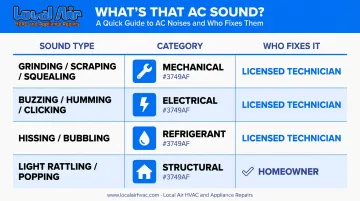
Step 3: Match the Noise to a Component Category
| Sound | Category | Who Fixes It |
|---|---|---|
| Grinding, scraping, squealing | Mechanical (motor/bearing/fan) | Licensed technician |
| Buzzing, humming, clicking | Electrical (capacitor, relay, contactor) | Licensed technician |
| Hissing, bubbling | Refrigerant (leak or pressure issue) | EPA-certified technician only |
| Light rattling, popping from ducts | Structural (debris, thermal expansion) | Homeowner check first |
Step 4: Apply the Fix or Call a Professional
What You Can Handle Yourself
Replace filters, clear debris, tighten loose panels, and check the condensate drain — a gurgling sound often means the drain line needs flushing.
When to Call a Technician
Some repairs require licensing: capacitor replacement, motor bearing repair, refrigerant leak diagnosis and recharge, contactor replacement, and compressor diagnostics. Refrigerant work specifically requires EPA Section 608 certification — attempting it without that credential is illegal and dangerous.
When choosing a technician, verify they hold EPA Universal certification. Local Air HVAC and Appliance Repairs has been EPA Universal Certified and serving Palm Beach County homeowners for over 20 years, diagnosing both indoor air handlers and outdoor condensers in a single visit.
Step 5: Test After Any Fix
Run a full cycle and confirm both the noise is gone and cooling output has returned to normal. If the noise persists or changes character, stop running the system — a deeper diagnostic is needed.
Which AC Noises Require Immediate Action?
Not all noises carry equal urgency. Here's a clear framework:
Shut Off Immediately — Call Today
- Grinding or metal-on-metal scraping (motor or compressor damage in progress)
- Loud banging from the indoor or outdoor unit (broken or dislodged component striking housing)
- Hissing near refrigerant lines, especially with reduced cooling (likely refrigerant leak — a health and system risk)
- Any noise accompanied by a burning smell or tripped circuit breaker (electrical fault — immediate fire risk)
Ignoring any of these signs risks turning a fixable component failure into a full system replacement.
Schedule Within 48 Hours
- Persistent buzzing or humming that's new (capacitor or electrical issue starting to fail)
- Squealing at startup (bearing wear that will progress)
- Repeated clicking without successful startup
Monitor and Address Within a Week
- Light rattling after clearing debris (internal component may need tightening)
- Occasional popping from ductwork (thermal expansion — usually normal in older systems)
- Chirping sounds (dry bearings, lower urgency but progressive)
Should You Repair or Replace Your Noisy AC?
When a noise diagnosis points to a major component failure, you face a straightforward decision: repair the existing unit or replace it entirely.
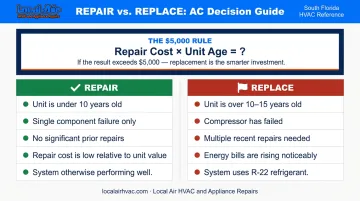
Use the $5,000 rule as your starting benchmark: multiply the repair cost by the unit's age in years. According to American Standard, if that number exceeds $5,000, replacement is typically the smarter investment. Central AC systems last 12–15 years on average — but Florida's near-constant runtime tends to push local units toward the lower end of that range, meaning your 10-year-old system may already be on borrowed time.
Replace rather than repair when:
- The unit is over 10–15 years old with a major mechanical failure
- The compressor has failed (repair cost often approaches the price of a new unit)
- The system has needed multiple repairs in the past two years
- Energy bills are rising alongside noise complaints — a sign of systemic efficiency loss
- The system uses R-22 refrigerant, which the EPA banned from new production after January 1, 2020; parts and refrigerant are increasingly scarce and expensive
ENERGY STAR flags any system over 10 years old as a strong replacement candidate. In South Florida's climate — where AC runs virtually year-round — that threshold often comes sooner than homeowners expect.
How to Keep Your AC Running Quietly
Most AC noise problems are predictable. Worn bearings, debris damage, dirty filters overworking the blower, capacitor failure from heat stress — these don't come out of nowhere. Routine maintenance catches them early.
Key preventive actions:
- Replace air filters every 1–3 months — Florida's pollen, dust, and near-constant runtime demand more frequent changes than the rest of the country. The DOE notes cleaner filters can cut energy use by 5–15%.
- Clear debris from around the outdoor unit monthly during heavy-foliage seasons (oak pollen season in spring is particularly bad in Palm Beach County)
- Listen to your system regularly — you know what your AC sounds like; changes are easier to catch early when you're paying attention
- Flush the condensate drain line periodically — a clogged drain can cause gurgling, backup, and moisture damage
- Keep the outdoor unit pad level — settling causes vibration that compounds into bearing and motor stress over time
Those five habits handle most of what homeowners can catch on their own. For everything underneath the panel, a professional tune-up before peak cooling season — ideally early spring — is worth scheduling.
Local Air's maintenance visits cover system cleaning, condensate drain care, refrigerant and electrical checks, and a full performance inspection. Catching a failing capacitor or low refrigerant charge during a tune-up costs a fraction of what an emergency repair call runs in July.
Frequently Asked Questions
Why is my AC making a loud noise?
Loud AC noises almost always point to a specific failed or failing component — loose or broken parts, motor bearing failure, a failing capacitor, or a refrigerant leak. Identifying the type of sound (banging, grinding, buzzing, hissing) is the first diagnostic step, since each noise maps to a different system component.
Is it safe to run my AC if it's making a grinding or banging noise?
No. Turn the system off immediately if you hear grinding, metal-on-metal scraping, or loud banging. Continued operation risks converting a repairable motor or blower failure into full compressor damage — a repair that can cost as much as replacing the entire unit.
What does it mean when my AC makes a hissing sound?
Hissing near the indoor or outdoor refrigerant lines most commonly indicates a refrigerant leak. This reduces cooling efficiency, raises energy costs, and poses a health risk from refrigerant exposure — shut the system off and call a technician.
Can a dirty air filter cause my AC to make loud noises?
Yes. A clogged filter forces the blower to work harder and can produce whistling, whooshing, or straining sounds. Replacing the filter is one of the first checks to perform before scheduling a service call — it resolves more noise complaints than most homeowners expect.
How much does it typically cost to repair a noisy AC unit?
Costs vary by component, system age, and labor. Capacitor replacements sit at the lower end; compressor work and refrigerant leak repairs run significantly higher. An on-site diagnosis is needed for an accurate quote — call Local Air at 561-331-7633.
When should I replace my noisy AC instead of repairing it?
Replacement is usually the better call when:
- The unit is over 10–15 years old
- The repair cost multiplied by its age exceeds $5,000
- The compressor has failed or the system uses R-22 refrigerant
- You've had multiple repairs within two years