
Introduction
Most homeowners clean the lint trap after every load and consider the job done. It's a reasonable habit — but the lint trap only catches a fraction of what passes through your dryer.
Behind the wall, a duct runs from your appliance to the exterior of your home, and over time, lint coats the inside of that duct like insulation. You can't see it. You can't reach it with a brush kit from the hardware store. And it's raising your energy bills, wearing down your appliance, and creating the conditions for a house fire.
This guide covers the real, measurable benefits of professional dryer vent cleaning: reduced fire risk, lower utility costs, longer appliance life, and healthier indoor air. Whether you're overdue for your first cleaning or deciding if annual service is worth the cost, here's what the evidence actually shows.
Key Takeaways
- Lint buildup is a leading cause of dryer fires — NFPA data attributes 32% of home dryer fires to failure to clean
- Clogged vents force the dryer to run longer, increasing energy consumption on each cycle
- Chronic airflow restriction accelerates wear on the heating element and motor, shortening appliance lifespan
- Blocked vents push moisture, microplastic fibers, and combustion byproducts back into your living space
- Professional cleaning reaches the full duct length, clearing buildup that standard DIY kits cannot access
What Is Professional Dryer Vent Cleaning?
The Lint Trap Versus the Vent Duct
These are two separate things, and most homeowners conflate them.
The lint trap sits inside the dryer door and catches visible debris after each cycle. Cleaning it regularly is good practice — but it doesn't address the exhaust pathway.
The vent duct runs behind the dryer, through the wall, and terminates at an exterior opening (or, in some configurations, through the roof). Every load pushes some lint past the trap and into that duct.
Over months and years, that lint accumulates along the duct walls, around bends, and near the exterior termination point. Consumer brush kits can reach a few feet in from either end. They cannot clear a full 10–20 foot run with multiple elbows, and they provide no way to measure whether airflow has been restored.
What Professional Cleaning Involves
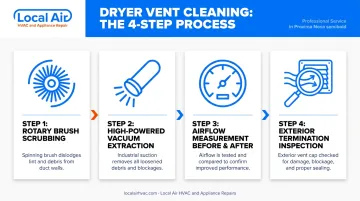
A certified technician clears the full duct run — from the dryer connection to the exterior termination — using equipment that goes well beyond what consumer kits can reach. A professional service typically includes:
- Rotary brush systems that scrub lint buildup from duct walls
- High-powered vacuums to extract debris without redistributing it
- Airflow measurement before and after to confirm the duct is actually clear
- Inspection of the exterior termination point for blockages or damage
That last step matters. Reduced airflow is often invisible until it causes a longer dry cycle, an overheating dryer, or worse — a fire. Professional cleaning catches what you can't see.
Key Benefits of Professional Dryer Vent Cleaning
Professional dryer vent cleaning produces measurable results — lower fire risk, reduced energy costs, a longer-lasting appliance, and cleaner indoor air. Here's what the evidence shows for each.
Fire Safety: Removing the Leading Cause of Dryer Fires
Lint is highly flammable. It accumulates inside the vent duct with every load — even when the lint trap is cleaned consistently. When lint enters or contacts the heating element, it can ignite rapidly. CPSC research found that lint samples began to ignite at approximately 452°C, and that lint ingested by the heater can produce embers capable of igniting additional lint or fabric in the airstream.
The scale of this problem is documented:
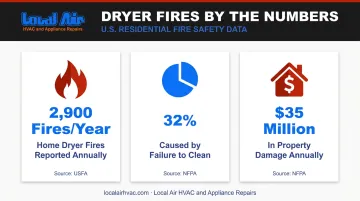
- The USFA reports approximately 2,900 residential dryer fires per year, causing 5 deaths, 100 injuries, and $35 million in property damage annually (2008–2010 data)
- USFA's current fire safety page notes that failure to clean was the leading factor in 31% of home dryer fires from 2018–2020
- NFPA's June 2020 report found 32% of home dryer fires were caused by failure to clean, with dust, fiber, or lint as the first item ignited in 27% of cases
Professional cleaning removes the full length of lint buildup that DIY methods cannot reach — especially in vents with multiple bends, long runs, or roof terminations. That directly reduces the probability of ignition.
This matters most for:
- Homes with long vent runs or multiple 90-degree bends
- Gas dryers (which add combustion exhaust considerations)
- Households running multiple loads daily
- Any home that hasn't had a professional cleaning in over a year
Energy Efficiency and Lower Utility Bills
A clogged vent restricts airflow. When humid air can't exit efficiently, the dryer runs longer to finish each cycle. That's more electricity or gas consumed per load — multiplied across hundreds of loads per year.
The DOE reports that electric clothes dryers consume about 782 kWh per year under normal use. A dryer forced to run extra cycles due to poor airflow pushes that number higher. DOE-hosted dryer-venting guidance recommends cleaning venting systems at least once a year to maintain performance.
Samsung and Whirlpool both confirm that clean, unobstructed ducting reduces drying time and improves energy efficiency.
A dryer completing one cycle instead of two per load cuts energy consumption in half for that session. In South Florida, where year-round warm weather keeps laundry demand consistent, those savings add up fast. Local Air HVAC and Appliance Repairs has helped Palm Beach area homeowners restore proper airflow and reduce their energy use for over 20 years.
Key signs your dryer vent may be restricting airflow:
- Clothes take more than one cycle to fully dry
- The dryer or laundry room feels unusually hot during operation
- Drying times have gradually increased over recent months
Extended Dryer Lifespan and Fewer Repairs
When airflow is blocked, the heating element and motor operate under constant excess load. The dryer runs hotter than its design parameters, components wear faster, and repair frequency rises. DOE-hosted dryer-venting research states directly that elevated heat inside the dryer cavity "probably also shortens the life of the components."
The repair cost data reinforces why prevention matters:
| Dryer Type | Median Repair Cost (Lower-Priced) | Median Repair Cost (Higher-Priced) |
|---|---|---|
| Electric | $133 | $215 |
| Gas | $149 | $192 |
(Source: Consumer Reports, 2024)
Consumer Reports also notes that dryers typically last about a decade with regular use. A dryer running in chronically restricted conditions won't reach that benchmark — and replacement costs far exceed what annual professional maintenance runs.
Moisture trapped in a clogged vent can also cause rust and water damage to internal components, compounding the wear. Professional cleaning removes the root cause before that degradation sets in.
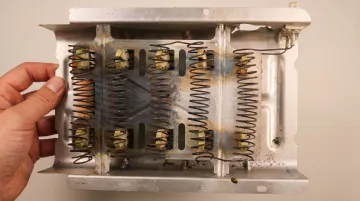
Higher-capacity dryers, multi-family laundry setups, and any appliance already showing longer-than-normal drying times are particularly vulnerable to accelerated wear from restricted airflow.
Better Indoor Air Quality and Home Health
A blocked vent doesn't just reduce efficiency — it changes where the exhaust goes. Instead of exiting outside, hot, moist air pushes back toward the living space. That exhaust carries three categories of concern:
- Microplastic fibers — An ACS study found a household tumble dryer released between 433,128 and 561,810 microfibers during a single 15-minute cycle. The paper notes that airborne microplastics can be inhaled and lists reported adverse health effects including COPD. Dryers not connected to proper outdoor ventilation allow these fibers to be released directly into indoor air.
- Excess humidity — The EPA states that improperly vented clothes dryers increase room humidity and may lead to mold growth, recommending indoor relative humidity stay between 30% and 60%. In South Florida's already-humid climate, adding dryer moisture to the indoor environment creates ideal mold conditions.
- Combustion byproducts (gas dryers) — The CPSC warns that CO is produced by incomplete burning of fuels and identifies venting defects and blockages as clues to potential CO problems, noting that only a trained technician can detect and correct hidden venting issues.
Professional cleaning restores the vent's intended function: exhaust exits the building, not the living space. For households with infants, elderly occupants, or anyone with respiratory sensitivities, that distinction is significant.
Palm Beach area residents can contact Local Air HVAC and Appliance Repairs at 561-331-7633 to schedule a professional cleaning. The company is EPA Universal Certified and has served residential and commercial clients throughout the region for over 20 years.
What Happens When You Skip Professional Dryer Vent Cleaning
The consequences of neglect don't arrive all at once. They compound gradually, which makes it easy to normalize warning signs until they become serious problems.
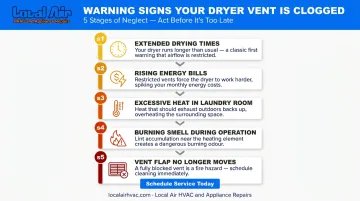
The escalation typically looks like this:
- Drying times creep up — one cycle becomes one and a half, then two
- Energy bills rise without an obvious explanation
- The dryer and laundry room run noticeably hotter than before
- A faint burning smell appears during operation
- The vent flap at the exterior opening stops moving freely
The measurable outcomes of a chronically clogged vent:
- Higher monthly utility costs from extended run times
- Shortened dryer lifespan from heat and motor stress
- Increased repair frequency and cost
- Elevated fire hazard from accumulated lint
- Degraded indoor air quality from exhaust backflow
- Potential clothing damage from excessive heat exposure
Most homeowners don't call for help until drying times double or they smell something burning. By that point, the duct is typically well past a minor blockage. Scheduled professional inspection catches lint buildup early — before it becomes a fire hazard or a repair bill.
How to Get the Most Value from Professional Dryer Vent Cleaning
Scheduling and Frequency
Professional cleaning works best as a scheduled annual service. For most households, once per year is sufficient. Certain situations warrant more frequent attention:
- Large families running multiple loads daily
- Pet owners whose laundry carries heavy fur and debris
- Households washing bulky items (towels, bedding, comforters) regularly
- Commercial or multi-family settings with high dryer utilization
These households may benefit from cleaning every 6 months.
Between Professional Visits
Maintenance between appointments is straightforward:
- Clean the lint trap after every single load — no exceptions
- Check that the exterior vent flap opens and closes freely during a cycle
- Watch for early warning signs: longer drying times, clothes with a musty smell, or a laundry room that feels unusually hot
- Don't use flexible foil accordion ducts if rigid metal ductwork is an option — flexible ducts trap more lint at each fold
Scheduling in Palm Beach
If you're in the Palm Beach area and ready to act on any of the above, Local Air HVAC and Appliance Repairs makes it easy to get started. Call 561-331-7633 to schedule professional dryer vent cleaning for your home or business. With over 20 years serving South Palm Beach County, EPA Universal Certification, and the 2024 Best Appliance Repair award in Royal Palm Beach, they're a dependable local option.
Conclusion
Professional dryer vent cleaning delivers compounding benefits across three areas: safety (reducing the documented fire and air quality risks from lint accumulation), savings (restoring dryer efficiency and extending appliance lifespan), and health (keeping exhaust — including moisture, microfibers, and combustion byproducts — out of your living space).
Most homeowners treat dryer vent cleaning as a reactive fix — something to schedule after the dryer starts running slow. But scheduled annually, like a furnace tune-up or HVAC filter change, it prevents consequences that cost far more than the service itself. The USFA attributes roughly 2,900 home dryer fires per year to failure to clean vents. That number alone justifies the appointment.
If you're in the Boca Raton area or anywhere in South Palm Beach County, Local Air HVAC and Appliance Repairs offers professional dryer vent cleaning as part of a broader commitment to safer, healthier homes.
Frequently Asked Questions
How often should dryer vents be professionally cleaned?
For most households, once per year is appropriate — both USFA and DOE guidance recommend annual cleaning by qualified service personnel. Households with heavy usage, such as large families, pet owners, or commercial settings, may benefit from cleaning every 6 months.
Can a clogged dryer vent actually cause a fire?
Yes. Lint is highly flammable, and CPSC research confirms it can ignite after contacting the heating element. NFPA data shows 32% of home dryer fires were caused by failure to clean, and USFA identifies failure to clean as the leading factor in 31% of residential dryer fires from 2018–2020. Regular professional cleaning directly addresses this risk.
What are the warning signs that my dryer vent needs cleaning?
The most common signs: clothes still damp after a full cycle, the dryer or laundry room feels excessively hot, a burning smell during operation, visible lint accumulating around the vent opening, or the exterior vent flap not moving during a cycle. Any one of these warrants a professional inspection.
Is professional dryer vent cleaning worth the cost compared to DIY?
For vents longer than 6–10 feet or those with multiple bends, professional service is significantly more thorough. Commercial rotary brush systems and high-powered vacuums clear the full duct length — including bends and inaccessible sections consumer kits can't reach — and airflow measurement tools confirm the vent is actually clear, something DIY methods can't verify.
Does dryer vent cleaning actually lower energy bills?
A clean vent restores proper airflow, allowing the dryer to complete cycles efficiently and reducing the number of cycles needed per load. The DOE reports electric dryers consume about 782 kWh per year under normal conditions — chronic vent restriction pushes that figure higher, adding measurable cost over time.
Are gas dryers more dangerous than electric dryers when the vent is clogged?
Gas dryers carry additional risk because they produce combustion exhaust. The CPSC identifies venting defects and blockages as clues to potential CO problems with gas appliances, and notes that only a trained technician can detect hidden venting issues. For gas dryer households, annual professional vent inspection is especially important.