
Dryer vent cleaning gets mentioned in safety checklists, but its financial case rarely gets spelled out. How much energy does a clogged vent actually waste? What does neglect cost in repairs and appliance replacement? And what's the real dollar value of eliminating a fire risk that insurance companies take seriously?
This article answers those questions with specific numbers, so Palm Beach homeowners can make an informed decision rather than waiting for a breakdown — or worse — to force the issue.
Key Takeaways
- A blocked vent forces the dryer to run longer and work harder, directly increasing energy use per load
- Restricted airflow can cut dryer energy efficiency by over 30%, per an ENERGY STAR manufacturer assessment
- Chronic overheating accelerates wear on heating elements, thermal fuses, and motors — components that cost $100–$350+ to repair
- NFPA data shows failure to clean causes 33% of clothes dryer fires, with annual property damage estimated at $221 million
- Professional cleaning typically runs $185–$430 and pays for itself quickly through energy savings alone
What Is Dryer Vent Cleaning?
Dryer vent cleaning is the process of removing accumulated lint, debris, and blockages from the duct that carries hot, moist air from the dryer exhaust port to the exterior of the home.
That last part matters. The lint trap inside the machine catches only a fraction of what gets produced each load. The rest travels through the duct — a pathway that can run 10, 20, or 35+ feet depending on where the dryer sits in the home — and accumulates along bends, seams, and the exterior vent cap.
Cleaning that full pathway isn't just a safety checkbox. A clear duct means:
- Cycles complete in the time the dryer was designed for
- The heating element or gas burner doesn't overwork to compensate for restricted airflow
- Components stay within normal operating temperature ranges
In short, a clean vent restores the airflow the dryer was built to run on — which is exactly where the energy savings start.
The Real Financial Case for Clean Dryer Vents
Lower Energy Bills with Every Load
The dryer is one of the most energy-intensive appliances in a home. The U.S. Department of Energy estimates electric dryers consume approximately 782 kWh per year under normal use. At Florida's residential electricity rate of 14.86 cents per kWh (EIA, March 2026), that's roughly $116 per year just to run the dryer — under normal conditions.
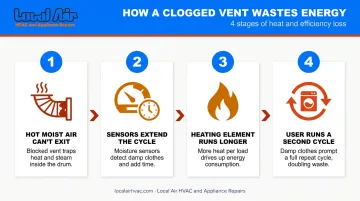
When the vent is clogged, "normal conditions" disappear. Here's what actually happens:
- Hot, moist air can't exit efficiently
- The dryer's sensors detect incomplete drying and extend the cycle
- The heating element or burner runs longer per load
- Many users run a second cycle when clothes come out still damp
An ENERGY STAR scoping report includes a manufacturer's finding that reduced airflow can decrease overall dryer energy efficiency by over 30%. Applied to that $116 annual baseline, a household could be spending $35–$40 more per year than necessary on electricity for the dryer alone — and that's before factoring in gas dryers or households running five or six loads per week.
Florida's climate adds another layer. High ambient humidity means clothes arrive at the dryer retaining more moisture than they would in drier climates. Any restriction in the vent amplifies cycle time further, compounding the energy penalty.
When this matters most: Households running four or more loads weekly see the savings compound quickly. For a family doing daily laundry, clearing the vent can have a measurable impact on the monthly bill within the first billing cycle after cleaning.
Extended Dryer Lifespan and Fewer Repair Bills
Restricted airflow doesn't just waste energy. It systematically damages the appliance. When exhaust can't escape at the designed rate, internal temperatures rise above the operating range the dryer was built for. That heat has to go somewhere, and it goes into the components.
The parts most affected by chronic overheating:
| Component | Common Repair Cost (Parts + Labor) |
|---|---|
| Heating element | $100–$350 (Angi 2026) |
| Thermal fuse | $5–$18 parts; fuses cannot be reset once blown |
| Drive motor | $60–$150 parts; labor additional |
Whirlpool's own documentation states that a blown thermal fuse is often caused by a clogged dryer vent. LG notes that a restricted exhaust duct raises internal temperature and can cause burning or discoloration of clothing. These are the predictable outcomes of prolonged restricted airflow, not edge cases.
The average dryer lifespan is 13 years, per Consumer Reports. With consistent vent maintenance, reaching that mark — or exceeding it — is realistic. Without it, recurring thermal fuse failures, heating element replacements, and eventually motor problems shorten that timeline, and each repair call chips away at the appliance's remaining value.
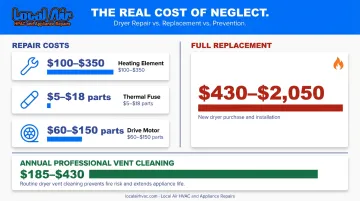
Replacement dryers run $430–$2,050 depending on type and features (Consumer Reports 2025). When you weigh that against professional vent cleaning at $185–$430 annually, one cleaning pays for itself many times over.
Most relevant for: Dryers that are 5+ years old, homes with longer vent runs (second-floor laundry rooms, roof exits), and high-usage households — all common scenarios across Palm Beach residential properties.
Eliminating the Financial Risk of a Dryer Fire
Lint is highly combustible. When it accumulates in a hot, restricted vent, the conditions for ignition are not theoretical. They're a documented statistical reality.
NFPA research covering 2010–2014 found that U.S. fire departments responded to an estimated 14,630 home fires involving clothes dryers per year, with $221 million in direct property damage annually. Failure to clean was responsible for 33% of those fires.
The financial consequences extend well past the appliance:
- Structural damage to the laundry room and adjacent areas
- Contents losses (clothing, shelving, flooring)
- Temporary displacement costs while repairs are made
- An insurance claim on record — which Experian notes can increase homeowners premiums by an average of 29%
Even a fire contained to the laundry room can easily produce $10,000–$30,000 in damage. Years of professional vent cleaning fees won't approach that figure.
Risk is highest when vents haven't been cleaned in over a year, when flexible plastic or foil ductwork is used (it traps lint more readily than rigid metal), and when dryers are located in interior rooms with longer duct runs — all situations that call for prompt attention.
What Skipping Vent Cleaning Actually Costs You
Neglected dryer vents don't fail all at once. The damage builds incrementally, and so does the cost.
The pattern is consistent across households:
- Drying times gradually extend, adding 20–30 minutes per load
- Energy bills climb with no single identifiable cause
- The dryer runs hot to the touch after cycles
- Thermal fuses blow, get replaced, then blow again
- Eventually the heating element or motor fails entirely
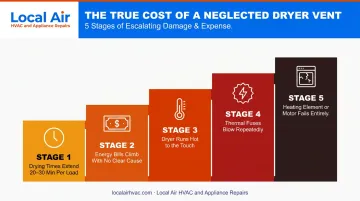
At each step, the household is spending money that a clean vent would have prevented.
There's a clothing angle too. Research published in a 2024 textile study found that tumble drying is associated with mechanical and thermal stress, textile damage, and fiber shedding. Extended cycles from vent restriction amplify that exposure — clothes wear out faster, elastic degrades sooner, and colors fade earlier than they should. That cost never appears on a utility bill, but it shows up every time you replace clothes ahead of schedule.
Beyond appliance wear and fabric damage, there's a more serious concern. The USFA notes that accumulated lint reduces airflow and can pose a fire hazard — a vent that hasn't been serviced in 12 months may already be significantly restricted, depending on household usage. Fire risk doesn't require years of neglect to develop.
How to Get the Full Value from Dryer Vent Cleaning
The benefits above depend on the entire duct pathway being clear — not just the lint trap, and not just the first few feet of duct accessible from behind the dryer.
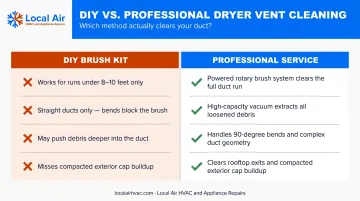
DIY vs. Professional Cleaning
Consumer brush kits can address accessible, short, straight duct runs. They fall short for:
- Runs longer than 8–10 feet
- Vents with 90-degree bends
- Rooftop exits
- Vents where debris has compacted near the exterior cap
Professional equipment — powered rotary brush systems and high-capacity vacuums — clears compacted lint from the full run and doesn't push debris deeper into the duct the way some DIY approaches can.
Recommended Cleaning Frequency
- Most households: Once per year, per NFPA safety guidance and LG's own manufacturer recommendations
- Higher usage or complex vent runs: More frequent service if drying times increase noticeably between cleanings
- Immediate inspection: Any time you notice clothes taking longer than one cycle, the laundry room running unusually hot, or a burning smell during operation
If your home falls into any of those higher-risk categories, a professional service is worth scheduling sooner rather than later.
Local Air HVAC and Appliance Repairs serves homeowners throughout South Palm Beach County and the surrounding area, including Boca Raton, Delray Beach, Boynton Beach, and Royal Palm Beach. With over 20 years of experience, EPA Universal Certification, and recognition as the Best Appliance Repair in Royal Palm Beach for 2024, their technicians clear the full vent pathway from dryer to exterior cap. Call 561-331-7633 to schedule a cleaning or discuss your home's specific vent configuration.
Conclusion
Clean dryer vents require recurring maintenance, and that consistency pays off in direct, measurable ways. Energy savings, avoided repair costs, extended appliance life, and fire risk elimination all compound over time. The longer the vent goes uncleaned, the more those costs add up.
If your dryer vent hasn't been professionally cleaned in the past year, you're likely paying more per load than necessary — and putting unnecessary strain on an appliance that costs real money to repair or replace. One service call fixes that. Local Air HVAC and Appliance Repairs has handled dryer vent cleaning for South Florida homeowners for over 20 years — call 561-331-7633 to schedule, and the return starts with your next load.
Frequently Asked Questions
Is dryer vent cleaning worth it to improve dryer efficiency?
Yes. Cleaning restores full airflow so cycles finish faster using less energy. ENERGY STAR research found restricted airflow can cut dryer efficiency by over 30%, meaning a single professional cleaning typically pays for itself within a few months.
What does professional dryer vent cleaning typically cost?
Nationally, professional dryer vent cleaning runs approximately $185–$432 (most jobs around $283, per Thumbtack 2025), with longer runs or heavy buildup pushing costs higher. Weigh that against the ongoing energy waste, repair risk, and fire exposure from a blocked vent.
How often should dryer vents be cleaned?
For most households, once per year is the standard recommendation from both NFPA safety guidelines and major appliance manufacturers like LG. If drying times have increased noticeably, or the laundry room feels unusually warm during operation, schedule a cleaning sooner regardless of when the last one occurred.
What are the warning signs that a dryer vent needs cleaning?
- Clothes still damp after a full cycle
- The laundry room feels hotter than usual while the dryer runs
- The dryer exterior is hot to the touch
- A burning smell during operation
- Drying times that have gradually crept up over several weeks
Can a clogged dryer vent damage the dryer itself?
Yes. Restricted airflow forces the motor and heating element beyond their designed temperature ranges, causing thermal fuse failures, heating element burnout, and motor wear. All of that shortens the appliance's lifespan and generates repair bills a routine cleaning would have prevented.
Does dryer vent cleaning reduce fire risk?
Yes. Lint is highly flammable, and NFPA data attributes 33% of the roughly 14,630 dryer fires per year — causing $221 million in property damage annually — to failure to clean. Removing lint from the vent pathway eliminates the primary ignition source, making annual cleaning one of the most effective fire-prevention steps a homeowner can take.