The short answer is that responsibility is typically split between the unit owner and the HOA, but which portions belong to whom depends on how your vent system is configured and what your governing documents actually say. This post breaks down the typical division of responsibility, how to get a clear answer for your specific building, and why the stakes are higher in a shared structure than most residents realize.
TL;DR: Quick Answers
- Unit owners are generally responsible for the dryer appliance, lint screen, and the short transition hose inside their unit.
- The HOA or condo association typically handles shared duct risers, exterior terminations, and building-wide scheduling.
- Your CC&Rs and bylaws are the definitive source; no general rule overrides what your governing documents actually state.
- When in doubt, get written clarification from your property manager, not just a verbal answer.
Why Dryer Vent Responsibility Gets Complicated in Condos
In a single-family home, one owner controls the entire vent path — from the back of the dryer to the exterior cap. In a condo, that same path runs through shared walls, ceiling chases, and vertical risers serving multiple units, meaning part of the system is yours and part belongs to everyone.
That shared infrastructure is what makes responsibility ambiguous by design. The Community Associations Institute describes dryer vents as a "mixed responsibility" item precisely because the duct conduit may originate inside a unit and then enter common area on the way to the roof or exterior — putting different segments under different ownership depending on where the boundary falls.
Florida Law Provides a Framework, Not a Final Answer
Florida Statutes Section 718.113 states that maintenance of common elements is the association's responsibility unless the declaration assigns limited common element maintenance to the unit owner. Dryer vents aren't specifically named — which means the governing documents for your community have to fill that gap.
Older buildings or associations with outdated bylaws may not mention dryer vent cleaning at all. Without a clear assignment, residents assume the HOA handles it, boards assume residents do, and the duct goes uncleaned for years.
The Climate Factor in South Florida
Florida's heat and humidity mean dryers run year-round. West Palm Beach averages 82% relative humidity in the morning hours, according to the Florida Climate Center. That sustained moisture load — combined with frequent use — puts more stress on vent systems than in seasonal climates, and significantly raises the risk of lint buildup and restricted airflow.
Unit Owner vs. HOA: Who Is Typically Responsible for What
This breakdown reflects how most condo communities divide responsibility. Your governing documents always take precedence.
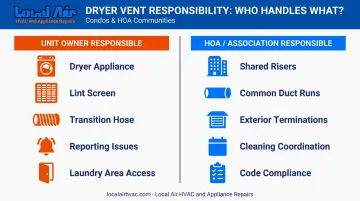
Typical Unit Owner Responsibilities
Unit owners are almost universally responsible for:
- The dryer appliance itself — purchasing, operating, and replacing it
- The lint screen — the U.S. Department of Energy recommends cleaning it after every single load
- The transition hose — the short flexible connector between the dryer and the wall duct, which must be a UL 2158A-listed metal duct no longer than 8 feet under Florida's building code
- Reporting performance issues promptly — longer drying times or heat buildup are warning signs that affect the shared system too
- Keeping the laundry area accessible on scheduled cleaning days
Foil accordion-style flex hose is still common in older condo units — and it's a fire hazard. Whirlpool's venting specifications explicitly prohibit flexible metal foil-type duct; only rigid or semi-rigid heavy metal vent is acceptable.
If your transition hose is the crinkly silver type, replacing it is your responsibility and your risk.
Typical HOA or Condo Association Responsibilities
The portions of a dryer vent system that cross into common property fall to the association:
- Shared vertical risers running through walls or ceilings between floors
- Horizontal common duct runs that consolidate exhaust from multiple units
- Exterior or rooftop termination points and vent hoods
- Building-wide cleaning coordination — scheduling vendor access across units, maintaining service records
- Code compliance for the common system, including cleanout access required by the 2023 Florida Building Code for multistory clothes dryer exhaust systems
Even when bylaws place cleaning responsibility on individual unit owners, many associations now coordinate building-wide cleaning programs. A clog in one unit's portion of a shared stack degrades airflow for everyone on that riser — and if a fire occurs because maintenance wasn't tracked or enforced, shared liability can follow.
How to Find Out Who's Responsible in Your Condo
Since responsibility varies by association and lease, getting a definitive answer takes three steps:
Read your CC&Rs and bylaws — Look for sections covering HVAC maintenance, appliance maintenance, or dryer venting specifically. Most associations make these available through the property manager or an online HOA portal.
Request written clarification if the documents are vague — Contact the property manager or association president directly. A written response protects you if a dispute arises later — verbal answers don't.
Review your lease if you're renting — Landlords in Florida can pass dryer vent cleaning responsibility to tenants through lease terms. Florida Statutes Section 83.52 requires tenants to use appliances in a reasonable manner, and your lease may impose stricter requirements. Failing to comply could create liability for damage caused by a clogged vent.
The Risks of Neglecting Dryer Vent Cleaning in a Condo
The consequences of skipping dryer vent maintenance fall into two categories: fire risk and everyday inefficiency. Both are more serious in a shared building than in a standalone home.
Fire Risk
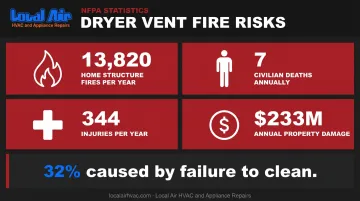
According to NFPA research, clothes dryers cause an average of 13,820 home structure fires per year, resulting in 7 civilian deaths, 344 injuries, and $233 million in direct property damage annually. Failure to clean is the leading contributing factor, responsible for 32% of dryer fires.
In a condo, a fire that starts in one unit doesn't stay there. Shared walls, corridors, and ventilation pathways mean neighboring units face real exposure — which is why building-wide maintenance isn't just a convenience issue.
Efficiency and Appliance Lifespan
Beyond fire risk, a clogged vent forces the dryer motor and heating elements to work harder on every cycle. The warning signs are easy to spot:
- Clothes that need two cycles to dry instead of one
- Longer-than-normal drying times on every load
- The dryer running hotter than usual to the touch
Each of these points to restricted airflow — and left unaddressed, the result is higher energy bills and a shortened appliance lifespan.
Liability Exposure
If fire or property damage occurs and either party — unit owner or association — failed to maintain their portion of the vent system, the negligent party faces potential insurance complications and legal exposure. Florida Statutes Section 718.113 explicitly defines the association's maintenance duty for common elements — and courts have consistently held associations accountable when that duty goes unmet.
How Often Should Dryer Vents Be Cleaned in a Condo?
At least once per year — that's the standard recommendation from both NFPA safety guidance via CSIA and major appliance manufacturers. Samsung specifically recommends cleaning once or twice a year, even when the dryer passes its built-in vent blockage test. Buildings with longer shared duct runs, heavy usage, or older vent systems should be cleaned every six months.
Clean sooner if you notice any of these warning signs:
- Clothes take more than one cycle to dry fully
- The exterior of the dryer feels unusually hot during or after a cycle
- A burning or musty smell during operation
- Visible lint accumulation around the wall vent opening or exterior cap
- The exterior vent hood flap isn't opening when the dryer runs
If any of these signs sound familiar, it's time to schedule a cleaning. Local Air HVAC and Appliance Repairs has served Palm Beach County — including Boca Raton, Boynton Beach, and Delray Beach — for over 20 years and handles dryer vent cleaning for individual condo units and multi-unit properties alike. Unit owners and property managers can reach them at 561-331-7633 to discuss your building's needs.
Frequently Asked Questions
Who is responsible for cleaning dryer vents in a condo?
Responsibility is typically split: the unit owner handles the appliance, lint screen, and in-unit transition hose, while the HOA manages shared risers and exterior terminations. The exact division depends on your CC&Rs and bylaws, which always take precedence over general guidelines.
How often should dryer vents be cleaned in a condo?
Most condo units should have dryer vents cleaned at least once a year. Units with longer shared duct runs, heavy usage, or older systems benefit from cleaning every six months. If clothes are taking longer than normal to dry, schedule service right away.
Can a clogged dryer vent in one condo unit affect neighboring units?
In shared duct systems, reduced airflow caused by a blockage in one unit can affect exhaust efficiency throughout the riser. The 2023 Florida Building Code recognizes this by requiring cleanout access and continuous exhaust fans for common multistory dryer exhaust systems.
What should I do if my HOA won't address a shared dryer vent problem?
Submit a written request to the board or property manager that references the relevant bylaw language and Florida Statutes Section 718.113. Document every communication. If the issue remains unresolved, escalate through the association's formal complaint process or consult an HOA attorney.
Do I need to notify my HOA before scheduling dryer vent cleaning in my condo?
For in-unit cleaning, prior notice usually isn't required. For anything involving shared ducts, building access, or exterior components, coordination with management is typically necessary and may be required under your bylaws.