Unlike a clogged filter or a tripped breaker, a refrigerant leak won't fix itself. Left alone, it leads to compressor failure, skyrocketing energy bills, and in South Florida's humidity, genuinely uncomfortable indoor conditions.
This guide covers how to recognize the signs of a refrigerant leak, where leaks typically develop, how certified technicians find and fix them, and how to decide whether repair or full replacement makes more sense for your system.
Key Takeaways
- Warm air, frozen coils, high humidity, and spiking energy bills are the main warning signs of a refrigerant leak
- Evaporator coils, condenser coils, fittings, and Schrader valves are the most common leak locations
- Certified technicians use electronic detectors, visual inspection, and nitrogen pressurization to find leaks
- Homeowners cannot legally handle refrigerant — only EPA-certified technicians can
- R-22 systems with leaks almost always make more financial sense to replace; ENERGY STAR recommends replacement for any AC over 10 years old with recurring problems
Warning Signs Your AC Has a Refrigerant Leak
Most refrigerant leaks don't announce themselves with a dramatic failure. They tend to show up gradually, which is why homeowners often live with a slow leak for weeks before calling a technician.
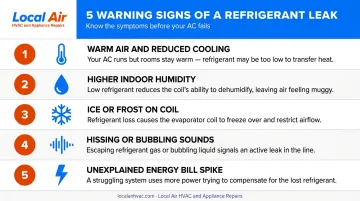
Watch for these five signs:
Warm Air and Reduced Cooling
Refrigerant is what allows your system to pull heat out of indoor air. When the charge drops, cooling capacity drops with it. Research from NIST found that a 20% undercharge reduced cooling capacity by 16–18% in a residential split-system test unit. If your AC is running but the house won't cool down to your set temperature, low refrigerant is high on the suspect list.
Higher Indoor Humidity
In South Florida, this one matters more than almost anywhere else. The same NIST simulation found that a 30% undercharge increased hours above 55% indoor relative humidity from 1,512 to 1,811 annually. If your home feels muggy even when the AC is running, that's a measurable performance drop, not just a perception issue.
Ice or Frost on the Coil or Lines
This one surprises most homeowners. Low refrigerant causes the evaporator coil temperature to drop below normal operating range, which freezes condensation onto the coil surface. Paradoxically, ice on the coil means less cooling reaches your home, because the ice acts as insulation and blocks airflow.
Hissing or Bubbling Sounds
A hissing sound near the indoor unit or refrigerant lines usually means refrigerant is escaping under pressure through a small gap. A bubbling or gurgling noise can indicate liquid refrigerant exiting at a leak point — neither is normal during operation.
Unexplained Spike in Energy Bills
The same NIST study found that a 30% undercharge raised seasonal energy use by 16%. The system compensates for reduced capacity by running longer cycles to reach the set temperature, consuming considerably more electricity along the way.
Where Refrigerant Leaks Most Commonly Occur
Not all leaks are in the same place, and location matters because it drives both detection difficulty and repair cost.
Common leak locations include:
- Evaporator coil (indoor unit) — one of the most frequently diagnosed sources, especially in aging systems
- Condenser coil (outdoor unit) — takes the brunt of Florida's outdoor heat, humidity, and physical exposure
- Refrigerant line connections and flare fittings — improperly torqued at installation, these can start leaking within months
- Schrader valve cores — these service access ports are used at every maintenance visit and are a documented source of slow refrigerant loss
- Brazed and soldered joints — stress fractures develop here over time, particularly in systems more than 10 years old
The Coastal Corrosion Factor
Homes in Palm Beach County's coastal areas face an additional threat: formicary corrosion. This is a pitting corrosion that occurs when copper refrigerant lines are exposed to moisture combined with organic compounds — a common combination in Florida's humid, high-traffic indoor environments. The result is pinhole leaks that are nearly invisible to the naked eye and difficult to locate even with standard detection equipment. Carrier's indoor coil corrosion research identifies formicary corrosion as a real failure mechanism, with incidence varying by geographic area and indoor environment.
Formicary corrosion isn't the only threat to refrigerant lines in Florida homes. Lawn equipment nicking an exposed copper line, or pests chewing through insulation near line connections, are causes your technician will ask about during diagnosis.
How HVAC Technicians Detect Refrigerant Leaks
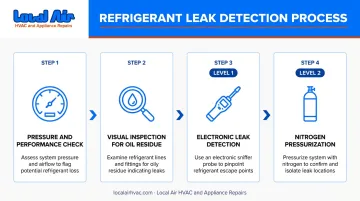
Finding a refrigerant leak isn't as simple as looking for a puddle. The process follows a logical sequence from confirming the problem to pinpointing the exact source.
Step 1: Pressure and Performance Checks
Before any search begins, a technician attaches gauges to the system's service ports. This confirms whether the system is holding correct operating pressure and verifies superheat and subcooling readings. The goal here is making sure a low charge — not a restriction or another fault — is actually the problem.
Step 2: Visual Inspection for Oil Residue
Refrigerant and refrigerant oil travel together in the system. At a leak point, oil will accumulate and leave a visible oily stain or residue on fittings, valves, coil surfaces, or line connections. A thorough visual inspection of all accessible components often narrows down the search area significantly.
Step 3: Electronic Leak Detection (Level 1)
An electronic leak detector uses a handheld probe to sense refrigerant gas concentrations in the air around the system. This is the standard first-pass detection method when the system still has enough refrigerant to produce a detectable concentration at the leak site. It covers ground faster than visual inspection and catches leaks with no visible oil residue. Once a suspected area is identified, a soap bubble test confirms active leak points — soapy solution sprayed on fittings or connections will visibly bubble at the source. It's a reliable confirmation step, but too slow to use as the primary search method.
Step 4: Nitrogen Pressurization (Level 2)
When electronic detection finds nothing but the system's behavior confirms a leak, technicians move to Level 2. This involves:
- Evacuating all remaining refrigerant from the system
- Isolating sections of the refrigerant circuit
- Pressurizing each section with dry nitrogen to manufacturer-specified PSI
- Monitoring each section for pressure drops and applying soap solution to suspect areas
This method finds very small leaks that electronic detectors miss. It's thorough, but it's also a multi-day process, and the system will be out of service during testing. The technicians at Local Air HVAC and Appliance Repairs are EPA Universal Certified and equipped to perform both Level 1 and Level 2 detection in full compliance with federal refrigerant handling regulations.
Refrigerant Leak Repair Options Explained
The right repair depends entirely on where the leak is, what refrigerant the system uses, and the age of the equipment.
Fittings, Valve Cores, and Minor Connections
The best-case scenario: the leak is at a Schrader valve core, a flare fitting, or another serviceable connection. A technician can tighten, reseat, or replace the component on-site, then evacuate the system and recharge it. This is the least disruptive and least expensive outcome.
Refrigerant Line Set Replacement
When the leak is in the copper line connecting the indoor and outdoor units, the line set typically needs to be replaced. Cost and complexity vary — lines that run exposed along an exterior wall are straightforward; lines routed through walls, attics, or slabs are significantly more involved.
Coil Replacement
Leaking evaporator or condenser coils require coil replacement. If the system uses R-410A refrigerant and is under 10 years old, the coil is often still covered under manufacturer warranty — which covers parts, but not labor. It's worth checking your documentation before authorizing this repair.
R-22 Systems: A Different Calculation
R-22 (commonly called Freon) was phased out of U.S. production and import on January 1, 2020, per EPA regulations. Any R-22 still available is recovered and recycled — and supply is constrained.
For older systems still running on R-22, the refrigerant type and equipment age combine to change the math entirely. The economics of a major leak repair almost always point toward full system replacement rather than recharge.
The Evacuation Requirement
Any proper leak repair must be followed by deep system evacuation before recharging. Carrier's service guidance calls for evacuating to 500 microns with a vacuum pump to remove moisture and non-condensable gases before new refrigerant is introduced.
Skipping this step leaves contaminants in the system that degrade compressor performance and accelerate compressor failure — often within a season. A technician who offers to simply "top off" refrigerant without evacuation after a confirmed leak is skipping a step that can turn a $300 repair into a $1,500 compressor replacement.
Should You Repair or Replace Your AC System?
This is the question most homeowners struggle with after a refrigerant leak diagnosis. The right call depends on your system's age, refrigerant type, repair history, and cost comparison — and each one can tip the scale.
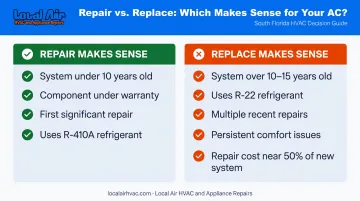
Factors That Favor Repair
- System is under 10 years old and in otherwise good condition
- The leak is in a component still under manufacturer warranty
- This is the first significant repair the system has needed
- The refrigerant type is R-410A or a newer alternative (not R-22)
Factors That Favor Replacement
- System is over 10–15 years old — ENERGY STAR recommends considering replacement at this threshold
- System uses R-22 refrigerant with a significant leak
- Multiple repairs have been needed in the past two to three years
- The system is causing persistent humidity or comfort problems
- Repair cost is approaching or exceeding 50% of a new system's installed cost
Efficiency is another piece of the replacement math. New split systems sold in the Southeast must meet a minimum 14.3 SEER2 rating — and if your current unit is a decade old running at 10–12 SEER, a replacement can cut monthly cooling costs by up to 20%, according to ENERGY STAR.
The repair-versus-replace decision is worth making carefully, not under pressure. Local Air HVAC and Appliance Repairs provides system assessments for Palm Beach County homeowners — evaluating equipment condition, refrigerant type, and repair history so you can make a clear, informed decision.
Frequently Asked Questions
Frequently Asked Questions
How much does refrigerant leak detection and repair cost?
Costs vary based on leak location and severity. Diagnostic visits carry a service fee, simple fitting or valve repairs are on the lower end, and coil replacements or full recharges run significantly higher. Refrigerant type heavily affects total cost — R-22 systems are more expensive to recharge due to limited supply. Get a specific quote from a certified technician before authorizing any work.
Where do refrigerant leaks most commonly occur?
The evaporator coil, condenser coil, refrigerant line fittings, and Schrader valve cores are the most frequent locations. Evaporator coil leaks are particularly common in aging systems, while Schrader valve cores can develop slow leaks that go unnoticed for extended periods.
Who should I call for refrigerant leak detection and repair?
Refrigerant handling is regulated by the EPA and must be performed by an EPA-certified HVAC technician. Adding refrigerant without EPA certification is illegal — and it won't fix the underlying leak anyway. Look for a licensed, certified HVAC company with documented experience in leak diagnosis.
Can I still run my AC if it has a refrigerant leak?
Avoid it. Running a low-charge system stresses the compressor, which can overheat and fail — a repair that costs far more than the original leak. It also accelerates refrigerant loss into the environment and delivers little to no useful cooling. Shut the system down and schedule service promptly.
Is a refrigerant leak dangerous to my health or the environment?
In poorly ventilated spaces, refrigerant exposure can cause dizziness, headaches, or respiratory irritation at high concentrations. Environmentally, R-22 depletes the ozone layer and R-410A is a greenhouse gas under EPA phasedown — intentional venting of either is illegal under Section 608 of the Clean Air Act.
How long does refrigerant leak repair take?
Simple repairs — tightening fittings, replacing valve cores, recharging — can often be completed in a few hours. Coil replacements typically take one to two days depending on parts availability. Extended leak testing methods may require the system to be out of service for several days.